In NYC? Love a Good Mystery? Come Visit the Library!
On Thursday evening, I’ll be on a panel with some really cool people at the Mid-Manhattan branch of the New York Public Library. You can find details on the library’s site, but here’s the flyer:


On Thursday evening, I’ll be on a panel with some really cool people at the Mid-Manhattan branch of the New York Public Library. You can find details on the library’s site, but here’s the flyer:
When I tell people that I’ve never written a query that didn’t result in a request for pages, they can’t believe it. When I tell them I ever sent out three (or six if you count the random assignments I was given to pitch to at conferences) queries, they are shocked.
But here’s the thing: I researched before I sent out my original set of queries. I looked not only at who represented what (which you can generally find on websites) but who sold what (which you can find out on Publishers Marketplace). I don’t care if an agent loves historical romance, if every sale she’s ever made is paranormal, she is probably not going to have the right set of contacts.
Because I belong to RWA, MWA, and Sisters in Crime, I am involved in a lot of discussions about queries. And I can also say that any query I’ve ever edited for someone has also resulted in a request for pages.
Your query is a super-important piece of writing. If you’re looking for an agent or editor, it may be the only piece of writing the people you want to take you on ever see. If you’re self-publishing, think of it as your cover copy—it’s the thing that’s going to make readers pick up your book.
A query letter has some basic pieces, but the one most people get wrong is the part that is like cover copy, the part that hooks an agent or editor and makes them want to find out more. Because that’s the trick—it’s not a synopsis that gives away everything in your book, it’s just a taste, a tease, a tempt.
This section needs to have three things and virtually nothing else:
I’ve included setting here because setting often has bearing on not only the goals and conflicts, but also on the subgenre. Someone who is looking for a small-town contemporary romance is not looking for an urban werewolf romance. You don’t need to describe the setting, just let me know where and when this takes place. The one exception to this is paranormal: in paranormal, you need a bit more world background. If your world has demons crawling up from the sewers, I need to know whether people are aware of them or not. Your world is a character, and it needs the bones sketched in.
What keeps the characters apart is vital, but I don’t have to know the details. For example, “When Molly’s fiance left her for his paralegal, she decided to stick with battery-operated boyfriends for the rest of her life.” Fine. I don’t need more. I don’t need her ex’s name or any of the details of their breakup. I don’t need to know that her father also left her mother—it will add character depth in the story, but it doesn’t need to be in the query. But let’s put Molly somewhere:
When Molly France’s fiance left her for his paralegal, she moved out of his Seattle apartment and back to the home where she grew up on Vashon Island with a chip on her shoulder and a suitcase full of battery-operated boyfriends to remind her not to trust any man. The old farmhouse, however, is in a bad way, and if she intends to use it as a home base for her new app-designing business, it’s going to need a lot of work. [OK, it’s not elegant, but I am making up as I go along, here.]
Now we have to give her a guy. He can either want her or not. Doesn’t matter, because her trust issues are enough to keep them apart.
Patrick Green has been trying to get off Vashon Island forever. Carpentry is all he knows, and saving sufficient funds to get a business off the ground in the city isn’t easy.
OK. Now, look, these two have nothing in common except that they live on the same island. If I am reading along in your query, I can see the conflict, but I don’t see any reason why he wouldn’t just ignore her completely, or why she wouldn’t just hole up in the farmhouse and nurse her wounds while looking for a job.
So we need to get them together, and keep them together. So…
Patrick Green has been trying to get off Vashon Island forever. Carpentry is all he knows, and saving sufficient funds to get a business off the ground in the city isn’t easy. When Molly first hires him to work on her house, all he sees is a path of dollar signs leading to freedom. But as passion flares between them he faces a difficult decision: will he give up the future he’s always wanted for the woman he’s beginning to love?
OK, like I said, it’s rough. But see how it sets up the situation without too many details? I don’t need to know that Molly has been working out of her boyfriend’s apartment in downtown Seattle for three years. I don’t need to know that Patrick’s parents died when he was nineteen and he’s had to take care of his siblings until this year. I don’t need the flesh of the story, just the bones. The bit that makes me go “yeah, let me see whether I want to read a few pages and see if I like the author’s voice and style.”
This is NOT a particularly good query, as far as I am concerned. Because it sounds to me as if the story is a bit empty. That’s because I haven’t written it yet and I am a pantser so I can’t write a query until after I’ve at least started the story.
Anyway, if you’re editing your own query, check and see whether you’ve hit those three points…and good luck!
 Are you an author? If so, and if you’re planning on going to Bouchercon, you should sign up today! Why? Because if you don’t sign up by June 1, you won’t be on a panel! So run over to Bouchercon 2014 — Murder at the Beach right now and then come on back and read the rest of this post. Don’t worry, I’ll wait.
OK, you’re back? WHAT? You haven’t left yet? Well, let me tell you why you should.
Bouchercon, for those of you who don’t know, is a reader and writer conference. No, you don’t have to be an author. Yes, your favorite mystery and thriller authors will be there. And this year, it’s in Long Beach. Say it with me…Long Beach. Nice weather when so much of the country will be miserable.
But even without the weather, even without the beach, B’con is so worthwhile. B’con 2012 was the place I first got the chance to meet my literary idol, John Connolly. (You can read about that encounter here.) Over the past few years, I’ve both moderated and sat on panels, and in both cases I really enjoyed myself. Because B’con is a fan conference, there’s a lot more interaction between readers and writers. Yes, it’s nice to socialize with writer friends the way one does at RWA or Sleuthfest, but at B’con you also get to meet people who have actually paid money for your books. Do you know what that’s like? Because it’s pretty darned fabulous. These are people who are literally invested in you.
 And, as a fan (because, yeah, if you didn’t get it from my pathetic reaction to John Connolly, I am a fan), it’s great to be able to meet the folks whose books you’ve invested in. The people whose characters you know and love. You can hang with them in the bar and find out their deepest secrets. You can go to panels and get the scuttlebutt on what’s coming next. Who has a movie deal? Who’s starting a new series? Get books that aren’t yet available to the general public. Get books signed. Oh, the books, the books!
There’s also a fair amount of general silliness at Bouchercon, like the 2012 cocktail party sponsored by criminalelement.com, where attendees were provided with a mugshot backdrop and various props…and went all out! (You can see the pictures on Pinterest.) Fans and authors alike were getting goofy, and it was all-around fun.
You just never know what’s going to happen at Bouchercon. (Last year, Clare Toohey and I got kicked out of a bar before the conference even began, which I admit is something of a record.) That’s part of its charm.
And if you’re shy, or uncertain about going to a conference, this is a great one to start with. Seriously. Everyone is super-friendly and very helpful. And did I mention it’s in Long Beach?
 If you ask someone who’s been married a few years about their spouse, you’re apt to get an answer that begins with “I love him/her to death, but…” That’s because marriage is hard. The falling in love part, the part we see in romance novels, may be angsty and difficult and there may be hurdles to be overcome, but we know—because we are reading a romance novel—that the hero and heroine will conquer the issues keeping them apart. By the end of the story we’ll see a committed couple.
But what happens in the “ever after” part of the HEA? I admit to being turned off by most of the “marriage and a baby” epilogues I’ve read. That doesn’t mean I want HFN endings, because I don’t. For me to feel satisfied by a romance, I need to see some kind of commitment between the leads by the end of the book. No, it’s not the “ever after” that frequently sticks in my craw, it’s the “happily.”
I’ve been thinking about this issue a great deal lately because I’ve found myself unable to believe that many of the relationships in the books I’ve been reading the potential to last beyond the time frame of the story. Partially, this is because I read a lot of romantic suspense. The nature of the genre is that characters spend a lot of time running, hiding, fighting…anything but talking to each other. Problem-solving is immediate and critical. You cannot argue too long about which direction you’re going to run or you’ll end up dead. So, yeah, by the end of the novel, he respects her fighting abilities and she realizes he has some emotional depth. That’s good. But it doesn’t exactly tell me that they’ll be able to resolve the issues that inevitably arise during a marriage. What if they can’t pay the bills? What if one of them gets a job offer halfway across the country and the other doesn’t want to move? If they’re both badass, high-powered, high-energy thrill seekers, who will take care of the kid that shows up in the epilogue?
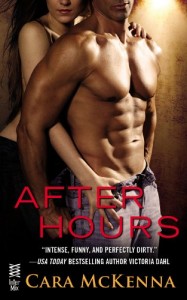
After Hours by Cara McKenna has a great and very realistic ending.
I am also a fan of contemporary romance, and I know I am not the only one frustrated by the number of stories in which the heroine is forced to move to a small town she hates at the beginning, is determined to return to the “big city,” only to find that by the end of the novel she is totally happy in that same town. There’s virtually never any question that the guy might move to the city or that, together, they might move somewhere entirely different. What about—*gasp*—the suburbs? Presumably the heroine enjoyed her life in the city for a reason and all too often the story never touches on how she will replace whatever she got from that life. Maybe she was a litigator or a high-fashion model or a gallery-owner. Will running a chocolate shop or starting a law practice that basically works on wills and real estate transactions give her the same satisfaction? I am not saying it won’t, I’m just saying that too often that question is ignored.
So, what does make for a good ending if it’s not a “happily ever after”? Well, to start with, it has to fit the story. I once read—and I wish I could remember the name, but I can’t—a book in which a woman’s tragic past included an emergency hysterectomy due to abuse. It was one of the great sorrows of her life that she would never have a child. But the guy she falls for has tons of cash and in the epilogue they’ve just returned from “overseas” where she’s had some “experimental procedure” and…she’s pregnant. Seriously. There was so much wrong there I just mentally blocked out the title and author. If you give a character a backstory like that, and invest me in it and in her desire to have a baby, the best kind of ending would be to show me how she and her lover work through the fact that she will never get what she wants. Don’t magically make it possible, show me how they deal with tough times. Then I will believe that when their house burns to the ground and they have to live in a hotel room for six months, they won’t drive each other nuts.

Bounce by K.M. Jackson seamlessly blends women’s fiction & romance
I am not saying that romance should change its focus to the reality of marriage. That’s been the mainstay of women’s fiction for a long time. Occasionally, the two cross—as they do in K.M. Jackson’s Bounce—but romance tends to be about the finding of love, not the keeping of it. And that’s fine. I love that. I don’t have any desire to change it. I just want a shot of realism injected into the ever afters. I am tired of the deus ex machina flying in at the last minute to solve problems that real life couples would have to adjust to, or one partner in the couple magically changing their mind.
So I am asking for recommendations: what books, old or new, in any subgenre, do you think do a particularly good job showing couples working through difficulties and making compromises?
Everyone has one. That one skill they simply cannot master. For a long time, it was drawing for me. When I tell people I cannot make a straight line with a ruler, they think I am kidding. I’m not. Seriously, it’s ridiculous. I have friends whose casual doodles during a single business meeting would take me four years to recreate.
Eventually, I gave up my dreams of being able to create, on paper, the images in my head. At least, as an artist. I do a fair job with words, but often they still seem clunky and imprecise to me.
 Currently, the skill that is frustrating me is knitting. I am a fiend for crochet. I can make most anything I set my mind to and have even written a couple of patterns of my own. Anything from a TARDIS notebook cover to a shawl of skulls, I’m confident enough in my crochet abilities to say “sure, I can do that.”
But knitting. Oy. I took a Craftsy class and it was great and I really felt like I knew what I was doing…but I hated every minute of it. Why? Because I had to concentrate so hard! I see these women knitting away on the subway and they don’t even seem to be looking at their work. How will they know if they drop a stitch? You basically can’t drop a stitch in crochet, and you’ll know within a row, two at most, if you’ve done something wrong.
 But knitting. OMG. Seriously. One misstep and the whole blasted thing unravels! When I expressed my frustration over the number of times I tore this project out, even with step-by-step video instructions on Craftsy, my knitting friends said “oh, yes, that’s just part of the process.” It’s what?”
One of my 2014 goals was to learn to knit. As you can see, I did finish that project…eventually. And I am pretty sure I know how to knit and purl. But I will never be able to knit like those women on the subway. I will always be worried about dropping a stitch…because I almost certainly will drop stitches. Right now I am knitting one of those endless cowls because I found some gorgeous yarn in New Orleans and decided I wanted to use it, but it’s not well-suited to crochet. But I’ve learned my lesson. There are no fancy stitches in this thing, just knit, knit, knit. And still, I fear it will (k)not come out right.
What skill would you like to master?