by Laura K. Curtis | May 23, 2014 | Books, Stuff! |
 The latest shots have been fired in Amazon’s bid to take over the world, or at least to become the Wal-Mart of the digital set. If you’re not familiar with their latest move, the NYT has covered it quite thoroughly in multiple articles.
This particular tactic doesn’t come as a surprise to me. I was already at Macmillan in 2010 when Amazon pulled buy buttons off all Macmillan’s books. And then there were a series of bad decisions—publishers should have chosen a different method than agency pricing, they should have told Apple that it wasn’t their business to fight Apple’s battles, and the Justice Department should have recognized that the publishers in no way, shape, or form were acting against the best interests of consumers. So, yeah, everyone screwed up. But anyone who didn’t see this coming has been living in a fantasy world.
Seriously.
As a reader, I appreciate my Kindle. But when there was a Borders in my town, I shopped there. Now, the closest bookstore is an hour away. I stop at Posman books in Grand Central when I pass it on a commute, but I really like electronic books. I don’t want Amazon’s handouts to those booksellers. I want individual bookstores to be able to sell me ebooks that are DRM-free that I can use a variety of devices and apps to open. I want to be able to pick my outlet, be it Amazon, an indie, B&N, or from the publisher itself. And wherever I buy a book, it should work for me, without my having to break through the technology with special tools. I was a huge fan of TotalBoox, which I talked about here when they first hit the scene. I still prefer their method of delivery to Amazon’s, but their UI sucks for genre readers and they don’t seem to be interested in changing it. This is the moment where they could REALLY make a difference, but without someone on staff to handle genre categorization, it’s not going to happen. But seriously, if someone wanted to take that job on, I’d be ALL OVER this service. They offer so much that Amazon simply cannot.
But that’s another post. This one is about my own discomfort not only with Amazon’s guerrilla tactics (see what I did there?) but also with people’s seeming surprise. We live in a capitalist society and for years we’ve been ignoring the increasing deregulation of businesses…which has almost always led to problems. Capitalism may be the best thing we’ve come up with, but it isn’t pretty and it isn’t fair. What on earth led people to think it was?
You may or may not believe that people are inherently greedy. That it’s a dog-eat-dog world. But however you feel you feel about people, you need to understand that companies, be they HMOs or Amazon, want only one thing: money. As much and as fast as they can get it. Bezos makes a lot of noise about how much better Amazon is for authors. Really? Macmillan authors didn’t feel that way in 2010. Hachette authors don’t feel that way now. Amazon is designed to benefit AMAZON. If, along the way, it accidentally benefits some other people too, well, that’s fine. But it’s not designed for that purpose. If every other book sales outlet failed tomorrow, and Amazon were the only place where you could sell your self-published work, do you believe you’d still get the same kind of terms from them? Because I don’t. Not for a second.
Think about it. Especially before you make your next purchase…of anything.
by Laura K. Curtis | May 20, 2014 | Books, Romance, Writing |
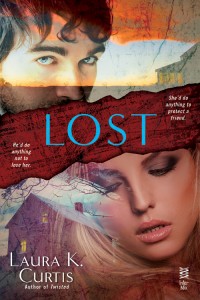 Can you tell I am just a tiny bit excited? Maybe even more so than I was for my debut. There’s something about the story of Lost that resonates for me in odd ways.
You can see an excerpt from the book on my site, and I am trying to come up with something cool to give away. I was hoping to see something while I was in New Orleans that would just speak to me, but I didn’t. If you were going to enter to win something, what would it be?
In the meantime, I have some pictures from my trip to the Romantic Times conference over on my Facebook page. It was madness. I’ve never been to RT before, so I don’t know if it’s always like that, or whether the combination of a bunch of crazed romance writers and the general decadence of New Orleans created the mania. Either way…wow. Just, wow. Even without drinking a Hurricane, the official drink of NOLA, I felt blown away!
More later, but for now, a few links to where you can find Lost:
All Romance eBooks
Amazon
Barnes & Noble
iTunes
Kobo
Enjoy!
by Laura K. Curtis | May 11, 2014 | Books, Romance |
Or, at least, I am GOING to New Orleans. It’s not really moving to NY. It’s the Romantic Times booklovers’ convention and I must admit to being a wee bit intimidated since it’s my first time at the con.
 But be that as it may, I am ready. Or at least as ready as I am going to be. Or at least, as ready as I am going to be after I pack on Tuesday evening.
If you’re going to the con, hit me up for some swag. My swag this year is little first aid kits with bandaids and first aid cream, for those new convention shoes that are leaving blisters on your feet. Or the paper cuts from bookmarks. Or the scrapes and scratches you aren’t sure where you picked up while out partying!
And if a brand new conference I’ve never attended before isn’t enough to stress out about, on Tuesday the 20th, my new book, LOST comes out. I am hoping to find some fun things at RT that I can give away to celebrate, so be sure to check back next Tuesday to see what’s going on!
by Laura K. Curtis | May 3, 2014 | Books, Writing |
 At the Edgar Awards the other night, I was talking to a friend about a debut book that had garnered quite a bit of acclaim a few years ago, but which neither of us had finished. The reason I couldn’t finish the book turned out to be the same as the reason she couldn’t: the author’s political agenda screamed from every page.
Now, this was an agenda I don’t happen to disagree with, but when I want analysis of political or ideological issues, I’ll grab some non-fiction. A bit of bleed-through is unavoidable—I’ve always said I don’t particularly worry about speaking freely online because if you don’t like my thoughts, you probably won’t like my books—but I don’t want to feel as if I am being hit over the head with a blunt instrument.
At lunch today I was seated next to a very nice couple. The service in the restaurant was … somewhat lacking … so we had a long time to chat. I had my notebook out and was writing and I was wearing a sweatshirt that said “Careful, or you’ll end up in my novel.” So they asked if I was a writer, and we talked about that, and then—because sports were on the TV in the restaurant and bigotry in sports is in the news—we got to discussing some political topics. And, it turned out, both the wife and I had grown up in NY, but left to go to college in the midwest. We had both been shocked at what we found in terms of sexism, racism, ethnocentrism, and homophobia. She is younger than I, and I found her experiences depressing—it was ridiculous that I should be the first Jewish person someone met at Washington University in St. Louis thirty years ago, but it’s worse that Northwestern was still segregated twenty years ago.
And, she said, the problem she really faced was that she was not Indian enough for the other Indian students. She fit nowhere.
After we talked, I went on my way and, as it does, my mind began replaying our conversation. I realized that my politics are actually not so far from my fiction as I might have at first thought.
Over the six-month period since Twisted was released, it’s been very gratifying to me to see people, particularly people whose opinions I value, examine it with some approval. Naturally, there was also some disapproval–that’s to be expected! But overall, people seemed to like it. What interested me most, however, was the analysis itself. Not “yay” or “boo” but the fact that people (both those I knew and those I didn’t) seemed willing to discuss it critically.
Twisted is, at its heart, a book about liminality and the powerlessness of those who live on the fringes of society. The murder that begins the book is the murder of a woman who lives on the edge both literally and figuratively—her house is near the woods, she makes her living as a prostitute, she drinks too much. And there are other murders (mostly of women) that are discussed (though not seen, as torture porn is a huge no-no in my eyes) throughout the book, some investigated some not, and the amount of investigation that goes into the crimes is in direct proportion to the victims’ position in society. In her analysis of Twisted, Olivia Waite says:
Of course, we do have all those nameless, faceless victims — rapes and murders and kidnappings, other cold cases that have never been solved, that may not have even been intensely investigated, which form the data constellation that helps our heroes solve Cecile’s murder. This constellation shows us exactly which groups of people are considered disposable in the small Texas town of Dobbs Hollow: prostitutes, illegal immigrants, and Hispanic women, no matter their class.
Well, yes. And although I knew that as I was writing the book, I didn’t realize it showed as much as it does. There is a certain mundane quality to evil that is hard to look at long enough to analyze. Hard to consider. Hard to face without sinking into a deep pit of despair. The idea that more people would commit more crimes if they weren’t worried about getting caught is a horrifying one. And yet, the wonderful thing about crime fiction, as Carolyn Hart said in her Grand Master address at the Edgars, is that it reaffirms for us that good does exist. That, in fact, good can triumph. And when we open a novel of a certain genre, indeed, we know that we will be transported to a place where good will triumph.
This means that every crime fiction novel presents to us, if we look, the exact ideal, the utopia of the author’s mind. In my utopia, there would be no distinction between fringe and center. No one would be victimized. People would be valued for everything they are and not devalued for what they are not.
But if I wrote that world, no one would believe it. So I write the world I see, which is decidedly less pleasant. But I write romance, which means that even though there may be a great deal of darkness, you know that the world of the novel will be better at the end than it is at the beginning.
by Laura K. Curtis | May 2, 2014 | Books, Stuff!, Writing |
Anyone who thinks the life of a writer is glamorous has been watching too many movies or too much Castle. In fact, most of the writers I know who don’t have to leave their house for day jobs or to take their kids to school spend a fair amount of time in sweats or pajamas. Their clothes have coffee stains and wrinkles. Their footgear is more often slippers or socks than heels.
But once a year, for the Edgar Awards, the ugliest award on the planet brings out the beautiful side of the mystery-writing community. Even I stuff myself into fancy clothes and head out for the evening. So without further ado, here are some of the fashions on display at the Edgars 2014:
 The latest shots have been fired in Amazon’s bid to take over the world, or at least to become the Wal-Mart of the digital set. If you’re not familiar with their latest move, the NYT has covered it quite thoroughly in multiple articles.
