
An Open Letter to John Sandford from Leigh Neely
This is part of a series of fan letters I am hosting in the hope of introducing some of you to authors other readers are passionate about! If you have a favorite author (living or dead) you’d like to write to or about, please let me know.
 Dear John,
Though your fans are legion, I wanted you to know how much I appreciate your writing and even your comments on Facebook. It probably helps that I agree with your political views, but in my book, that just makes you a better writer.
You are at the top of my short list of writers I buy in hardback. I’ve read all your novels. In fact, I always put your release dates on my calendar when they’re announced. I even looked up some of your articles. Guess what. I enjoyed those too.
Your writing style appeals to me in so many ways. It’s clear, concise, and at times, breathtaking. You write with a journalist’s eye for the big questions: who, what, when, where, and best of all, why. Your writing had an intuitive air I envy so much. You obviously understand the psychological elements of your characters and the inner motivations for their actions. Your humor keeps me laughing. Life is nothing without humor, and as the cousin of a homicide detective, I truly appreciate that he’s one of the funniest people I know.
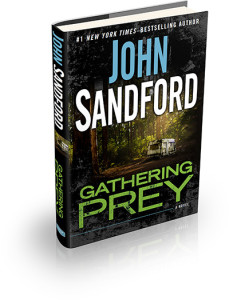
I’m sure you do extensive research for these books, but that doesn’t get in the way of a damn good story…ever. When I read the Facebook posts, yours and your son’s, I’m always baffled by those party poopers who want to point out what you did wrong. There are errors in all novels, but I seldom notice them in yours because I’m so anxious to find out what’s going to happen next. I recently read Gathering Prey in a day and a half. Thank goodness I work from home so I was able to read until the wee hours without worry.
I met Lucas Davenport through an audiobook. Unlike Lucas, I don’t listen to music much (but when I do, my list is similar to his), I listen to audiobooks in my car. Normally I’d listen to these books, and then I’d trade them for others at the used bookstore. But after I listened to my first Prey novel, I headed to the bookstore to start at the beginning, Rules of Prey, which features an appropriately named killer called Mad Dog. Is there anything more chilling than a crazed killer contemplating his latest murder by thinking, “She had never seen her sixteenth year” with absolute pleasure?
Lucas is a close friend to me now. I love his reckless way of hunting the bad guys and his impeccable taste in clothes and cars. He’s intelligent, charismatic, and damned good looking. In spite of his need to take risks, I believe he enjoys life. Like any good hero in a novel, he’s neither completely good nor completely bad. That’s the beauty of a character that stays with you. However, there’s one thing you know for certain—when Lucas gets a bad man or woman in his sights, he’s relentless until justice is served. He may serve his own kind of justice, but it’s never a disappointment for me when he does.
I love Dale, Shrake, Jenkins, and Sandy, but I have to say my favorite supporting characters are Letty and Weather. I seldom cry when I read books, but the ones that have featured these two prominently brought me to tears on more than one occasion. It has been wonderful to watch the resourceful Letty grow up with Lucas and Weather. What Lucas feels for his adopted daughter is very special, and the relationship between him and Weather is just plain great. I especially like that they have added the two babies to the household. The fact that he has never cheated on her is amazing in this age of adultery being almost in vogue.
To write these rich, compelling stories time after time is a gift, and apparently yours is boundless. Here’s one of my favorite scenes from Gathering Prey.
He made the cabin by three in the morning, stopping once at an all-night gas station in Hayward for gas, Diet Coke, a quart of milk, and a box of Honey Nut Cheerios. The cabin was dark and absolutely silent as he bounced up the driveway, until he triggered the motion-sensor floodlight on the garage. The only other visible light was on his neighbor’s porch. He was unlocking the front door when the neighbor came out in a T-shirt and underpants and yelled, “Lucas?”
“Yeah, it’s me.”
“Good, I don’t have to shoot you. How long you up for?”
“Just overnight,” Lucas yelled back.
“Have a good one.”
He went inside and had a bowl of cereal, the moon hanging low out over the lake, putting a long streak of silver on it. It was cool, almost cold. He got a spinning rod from a closet, went out on the dock and spent five minutes casting a Rapala into the moonshine, trying for bass or pike, but not trying too hard, smelling the North Woods night, looking at all the little dots of light from the cabins around the lake; then he went inside and tried not to dream about Skye, and what might have happened to her.
I was there with Lucas, smelling the clean, crisp night air, feeling my muscles relax because I was in a good place, and trying to avoid thinking of the reality for a young girl with rash judgement. I can find scenes that touch me like this one in every one of your books, John. Every time I finish one, I have a great fear there won’t be a next one.
 Alas, I’m a woman with no morals when it comes to your men for I am also deeply in love with Virgil Flowers. Again, I can see him as easily as if he were standing next to me. The long, blonde hair, the sinewy body, the wolf’s gleam in his eyes, and the smile that makes every woman wish she looked like Jennifer Anniston so she’d be worthy of sleeping with “that fucking Flowers.”
I love Virgil’s thoughtful nature and how he wishes he never had to use his gun. The characters he deals with in the little towns that fill Minnesota are priceless. The humor makes me laugh out loud.
In this scene where I first met Virgil Flowers, I felt a kinship I’ve never felt with another hero. I was raised in the South and though I’m a liberal thinker, I grew up in a nest of independent, fundamental, premillennial, Bible-believing, missionary Baptists. When I began thinking for myself, I realized I no longer wanted to blindly accept what my parents and my pastor had always told me. That’s why Virgil is quite literally my soulmate.
Every night, before he went to bed, Virgil Flowers thought about God.
The practice was good for him, he believed, and saved him from the cynicism of a cop’s life. Virgil was a believer. A believer in God and the immortal soul, though not in religions—a position that troubled his father, a Lutheran minister of the old school.
“Religion is a way of organizing the culture, your relationship to God and the people around you,” his father argued the last time Virgil went back home. “It’s not a phone booth to God. A good religion reaches wider than that. A good religion would be a value in itself, even if God didn’t exist.”
Virgil said, “My problem with that is I don’t believe God cares what we do. Everything is equally relevant and irrelevant to God. A religion is nothing more than a political party organized around some guy’s moral views, Confucius, Buddha, Jesus, Mohammed, like conventional political parties are organized around some guy’s economic views. Like Bill Clinton’s.”
His father disdained Bill Clinton, but he took the shot with appreciation.
I absolutely love this scene. If I told my mom I disagreed with her political or religious views, she’d be so upset she’d cry for days and spend the rest of her life trying to get me to admit I was wrong. So I just keep my mouth shut and enjoy my personal relationship with God and politics.
Virgil and his dad, however, do it the right way.
Virgil had been raised in a church, and the problems his father dealt with, he thought, would have driven him crazy. It’s relatively easy to solve a problem with a gun and a warrant and a prison; but what do you do about somebody who is unloved?
Better, Virgil thought, to carry a badge, and maintain your amateur status when it came to considering the wonders of the universe.
There are all kinds of writers, but you, John Sandford, are one of those rare ones—a consistently good storyteller. Just wanted you to know I appreciate it and hope you can keep writing forever.
Sincerely,
Leigh Neely
Leigh Neely writes paranormal fiction with co-writer, Jan Powell. A former newspaper and magazine editor, Leigh is also a prolific nonfiction writer. She is the author of “A Vampire in Brooklyn,” featured in Murder New York Style: Fresh Slices, and “My Brother’s Keeper,” a short story in Murder New York Style: Family Matters.


