by Laura K. Curtis | Oct 7, 2014 | Books, Writing |
Several things came together this week—the continuing uproar over the Authors United letters and/or the Amazon-Hachette issues along with Ellora’s Cave suing Dear Author—to create this post. I have many, many things to say about this, so the post is apt to be rambling and a little harsh, so I’ve illustrated it to make it a little more entertaining. And I won’t blame you if you abandon it in the middle going:

OK, got your coffee?
First, the Ellora’s Cave issue since it’s the one that got me started thinking of this post. A week or so ago, publisher Ellora’s Cave filed suit against blogger Jane Litte and her blog, Dear Author. Most of the reactions I saw were along the lines of “OMGWTFBBQ”, but several self-published authors also came out and said, if not in so many words, about the suffering Ellora’s Cave authors, “nah nah, now I bet you’re sorry you didn’t self-publish.”
This seems incredibly, unbelievably short-sighted to me. And it seems short-sighted in the same way as it did when these same authors went “Who gives a damn if Amazon bullies one or all the major publishers out of existence? They deserve it for offering their authors such crappy terms, etc.” And I say this as a self-published author.
Because here’s the thing: unless you’re selling your copies of your self-published book out of the back of your van, you’ve signed contracts with distributors. If you’re smart, you’ve signed contracts with multiple distributors. And I damn sure hope you read all of those contracts. Every last word.

I’m not talking about hitting the highlights of your contract with Kobo or iTunes or B&N or Amazon. Not just “this is how much I make per copy sold” but “this is what I am allowed to do and when I am allowed to do it.” Being self-published doesn’t mean being independent. In fact, unless you’re selling all your books directly off your own website, you’re highly dependent and you need to know what you’ve agreed to do or not do. Your contract with your book’s distributor is not like the latest upgrade agreement to Microsoft Word. (Does anyone actually read those?)
The Ellora’s Cave lawsuit is about stopping a blogger from discussing news important to the publishing industry. Whether you happen to like that blogger, like that blog, like the authors or the publisher involved, it is vitally important that conversations on topic like this not be stifled. Because as an author, as a producer who creates the content, you’re at the mercy of your distributors. (Yeah, some people can make enough selling direct off their websites or out of the back of their vans. But I’m betting the vast majority of us can’t.) So if you don’t know whether your distributors are fiscally healthy, or sane, or if they give contract terms that are standard in the industry, you don’t know what you should sign. And that matters whether you’re traditionally published, self-published, or anything in between.
And your distributor contracts may change during the course of your career, so you can’t just sign and forget about them, either. You may not be interested in Ellora’s Cave, but if EC should win that lawsuit (highly unlikely, IMHO), other sites will be less interested in exposing failures of other distributors. Since you read your contract with your distributor, you saw the part where it says that they can change the terms when they like, right? Well, when those changes happen, you read the information they send you about it, but what if you don’t understand it exactly? If publisher-agnostic sites are frightened to speak up because of lawsuits, where do you go for help?
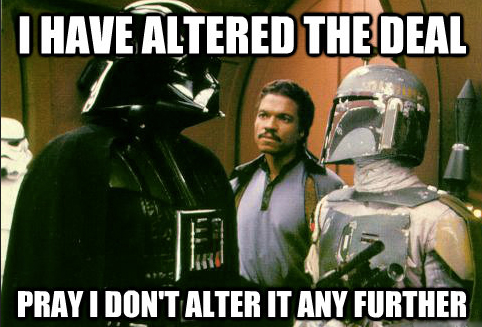 Now, of course, you have the right to pull your books out of distribution if you don’t like what what your distributor wants to do, but that’s about the only card you hold. Which is basically what’s going on with Hachette and Amazon right now. Amazon wants something and Hachette wants something else. It’s as simple, and as complex, as that. Stop for a minute and consider this: Hachette has thousands of authors, millions of dollars tied up in Amazon and they can’t get any traction in a negotiation. Do you think you will be able to if you decide you’d like to alter your deal?
I’m not a big fan of the Authors United approach. Their letter to Amazon’s board smacks of egoism and “special snowflake syndrome.” But I am even less a fan of monopsonies. I have said before that it is my absolute belief that if Amazon controls the book market, everyone—including self-publishers—will suffer. Why? Because it is not in the nature of corporations to offer favorable terms unless they absolutely have to.
This is essentially what happened with Audible—once Amazon/Audible controlled the audiobook market, they cut the royalties they gave producers/authors in half. Once they have the market, why should they pay more? And if they cut royalties, chances are authors will raise their book prices to make up some of what they lose. Which means consumer prices go up.
A competitive marketplace, with multiple distributors and lots of clarity and openness, where people are allowed to speak their mind and discuss the details of their contracts and sales, benefits everyone. It doesn’t matter whether you’re a writer or a reader. Anything that stifles discussion or creates monopolies or monopsonies should be fought tooth and nail, no matter what your publishing path may be.
by Laura K. Curtis | Oct 4, 2014 | Writing |
I may have mentioned here a time or two that I am an insomniac. Most of the time, I lie awake and toss and turn and worry and freak out about stuff I can’t handle. Occasionally, my brain turns to more productive matters. Of course, it’s never provides me with useful information about the work I am supposed to be doing (in this case, a project tentatively entitled Mind Games and set for release in November of 2015), but always something else completely.
Last night, it gave me the outline of Nash Harper’s book. If you’ve read Lost, you’ve met Nash, if only in passing. Over the next couple of books, he’ll become more important as his company, Harp Security Enterprise, begins to take center stage. But I hadn’t really considered Nash as a lead. He’s the man of mystery, the big boss, and even to me he was sort of a shadow figure.
Now, obviously, I’m not going to give you all thousand words I wrote last night…I don’t want to give away the story before I even figure it out. But I’ll pass along two paragraphs for the sake of entertainment. As usual, since it’s the beginning of the book, I’ll probably end up deleting it. But in case you’re curious about HSE, here’s a snippet.
Harp Security was not the kind of place that welcomed casual visitors. In fact, the name appeared nowhere on the outside of the building. Even the occasional lost tourist poking a head inside to ask the uniformed guard for directions could be forgiven for mistaking the 12-story building in Manhattan’s trendy TriBeCa neighborhood for nothing more than another expensive apartment complex. Which was just how Nash Harper liked it.
Only those who knew precisely what to ask for made it past that guard, and they were carefully screened by on-duty operatives before being allowed into the reception area. So when Nash’s assistant Lexie called him from reception to tell him they had a guest who wouldn’t give his name, Nash took a brief moment for a weapons check before stepping out of his office.
Now, back to work on the one that’s due!
by Laura K. Curtis | Sep 18, 2014 | Books, Romance, Writing |
So now that I’ve gotten my contract back and it’s all official and everything, I can announce that I have two more books coming from Penguin in April and November of 2015. They’re as yet untitled, but they will be romantic suspense, loosely related to each other and to TWISTED and LOST.
Also, if you’re interested in contemporary romances, I’ll have another one of those next year as well. I’d love to be able to promise you an exact date, but I can’t since it’s self-pub and highly dependent on the schedules of all the great people who help me get the self-pub work to market.
 To celebrate all this fun stuff, I am offering 20% off my contemporary romance in both print and ebook (and the sweet zombie short story I co-wrote) through my Storenvy store. Just click the picture at right and use the coupon code 20BLOG at checkout. This coupon expires October 1 at 6pm Eastern.
by Laura K. Curtis | Sep 9, 2014 | Stuff! |
PERSONAL SAFETY:
Artists, authors, musicians, crafters…if you’re in a creative business you need to get the word out about yourself and your work. People need to associate you with your product. As a marketing and “branding” professional, I spend a lot of time giving people advice on how to get “out there.”
But today I want to take a step back and talk about how to keep yourself safe while you do that.
1) Do you have a newsletter? Newsletters are excellent for getting word out about what you’re doing and where you’re going to be. Got a new book? Showing your work in a gallery? How will those who are interested find out? You need a newsletter. There are a number of good services: MailChimp and Aweber are the two I hear about most often. But the CAN-SPAM Act requires that at the bottom of your newsletter you have your FULL PHYSICAL MAILING ADDRESS.
That’s right. You need to have a physical address. It’s the law. But anyone can sign up for your newsletter and you have no idea what kind of crazy you might inspire with a totally innocent email update, so don’t put your home address there. Most everyone I know uses a post office box. You can get them at the actual post office (the problem with this is that you get a lot of junk mail) or at a local Fed Ex or UPS store. You can register those addresses under your pseudonym with no problem. If you’re mailing out contest prizes, etc, you should also use that address. Nothing “professional” should go through your home.
2) Do you have a website? Did you know that if you do, and you don’t have “domain privacy” enabled, anyone can backtrace your information to get your home address and phone number? All they have to do is go to whois.net and enter your website’s URL. This is not something you want. AT ALL. Most hosts charge about $10/year for domain privacy. If you cannot figure out how to enable it on your domain, just call your host and have them do it for you.
Here’s what my “Whois.org” looks like because I have privacy enabled.
Registrant Name: DOMAIN PRIVACY SERVICE FBO REGISTRANT
Registrant Organization:
Registrant Street: 1958 SOUTH 950 EAST
Registrant City: PROVO
Registrant State/Province: UTAH
Registrant Postal Code: 84606
Registrant Country: UNITED STATES
Registrant Phone: +1.8017659400
The privacy service my host uses is in Provo, so that’s what shows up. Not my information at all. There are privacy services all over the world, so the place your registrar will show could be anywhere.
3) Do you share personal things? The way to make connections to your audience is through personal, authentic connections. But you want to be careful what those things are. Don’t take pictures of your kids in your backyard with your phone or other cell-enabled (or, for that matter, gps-enabled) device. Want to know why not? Did you realize that the metadata of the picture contains geographical data? Yes, you can strip it before posting, but not if you post directly from your phone to the web, etc. Creepers may not know how to extract it, but if they’re TRUE creepers, they will. (If you have a Mac, open the photo in iPhoto and do COMMAND-I — over on the right side you’ll see the metadata, including a map showing where you took the picture.)
True creepers cannot be avoided. These people are stalkers and need to be avoided at all costs. But taking the three precautions above are a good start to keeping the casual asshole from getting hold of information you don’t want him to have.
PROJECT / WORK SECURITY:
This is completely different, but I want to take a moment to remind you about it because so many artists and authors I know have had really bad (REALLY BAD) problems with data loss.
Your data should be in several places, at least one of which is off-site. If your house burns down, you don’t want to run in and try to save your laptop; you want to GTFO and know that you’ll be able to get everything back from your offsite backup.
You shouldn’t depend on a system that forces you to back up your work when you finish a session. An author friend once told me that she always backed up post-session so she didn’t worry…until she lost 4000 words when her hard drive failed mid-session. If you’re just mailing your work to yourself, you’re not doing enough. Plus, you’re not saving files like your personal dictionary, your profiles, etc.
“But if I save it on the cloud, someone might steal it.”
Yeah, they might. I SERIOUSLY doubt it. I’ve never heard of plagiarism occurring that way, mostly because it’s too damned hard. There are so many easier ways to get your book. Plus, what good would half a book do them? They’d have to write the rest!
So, go for a several-level protection strategy.
Mine, and I admit I go a bit overboard, is:
1) I set both Word and Scrivener, which I use for writing, to 5-minute backups. I also take “snapshots” in Scrivener so I can go back to earlier versions. (If you didn’t know it, you can sneak back into previous versions of Scrivener files even without snapshots…look it up, you won’t be sorry!)
2) I keep all important documents, all works in progress, etc, in the DropBox folder on my harddrive. That means that any time I am connected to the Internet, the DropBox files sync. I don’t have to be working on the file, I just have to be connected to the ‘Net.
3) In-house backup every half hour. I use Time Machine, which backs up over my home network. I LOVE Time Machine because it’s super easy for me to go back to a half hour ago, or an hour ago or three hours ago and pull a necessary file I’ve somehow screwed up or thrown out. But it’s not the most reliable program in the world, so you do have to look at it every once in a while to be sure it’s maintaining its backups.
4) COMPREHENSIVE, full-machine, off-site backup using CrashPlan. I have also heard good things about Carbonite, but I cannot speak for that. I can speak for CrashPlan, which backs up every…I don’t recall exactly…15 minutes or something to an off-site location. That’s my whole computer (so is Time Machine, but like I said, it’s not entirely reliable). Anything that gets lost can be brought back. That ridiculously complicated Dragon Dictate profile that allows it to spell all the character names in your series? It’s in there.
Each level of these is more complicated to access, obviously. If I just want to grab the last version of something in Scrivener, that’s easy. Dropbox keeps old copies, too, so I can grab one of those. Time Machine requires some fiddling, but I can get it. And CrashPlan makes it a little harder. But I have never, ever, lost more than a few minutes worth of work. And when my computer completely croaks and I have to take it in and leave it at the shop so they can replace the hard drive, and they ask me whether I need data recovery, I just smile and say “no thanks.”