by Laura K. Curtis | Dec 29, 2012 | Books |
 Never doubt that Evil exists. Not the little evils of the world, like the teenager selling dope on the corner, or the thief who breaks into your apartment to steal your television so he can buy the dope from corner guy. Not even the classroom bully who assuages his own insecurities at the expense of others. No, the Evil of John Connolly’s world, the world that will become yours from the very first page of The Wrath of Angels, is pervasive and permeating, a deep current running beneath the world and rising in the mist of the dark woods surrounding the fallen plane.
Nothing so simple as vampires, as werewolves, as zombies inhabit Connolly’s world. Evil is too subtle for such displays. And yet, his characters are aware of it in the same way normal people are, the same way we understand by instinct that which we cannot name.
[Read my full post about The Wrath of Angels at Criminal Element]
by Laura K. Curtis | Dec 8, 2012 | Books, Fan Corner |
This is a piece I wrote about a year ago for Criminal Element.
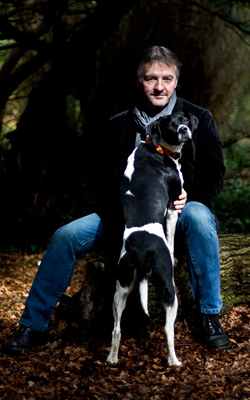 Every once in a while, an author comes along who resonates with you on some level, whose books you cannot put down, whose work you will seek out even if it’s not your “usual thing.” I don’t remember who first recommended John Connolly to me, but if I did, I’d have to take them out to dinner or something for the numerous hours of enjoyment they’ve brought me over the years.
Of course, my dinner-buying budget has been stretched rather thin by the fact that since reading my first Connolly, I’ve felt compelled to buy each hardcover the minute it comes out, and now I buy both that for my collection and the ebook to carry with me and read. The book that started my addiction was the first in Connolly’s Charlie Parker series, Every Dead Thing. Right at the beginning, Parker’s wife and daughter are murdered. From then on, through the next several books, rather than fading from his memories and life, they become more and more present to him. As readers, we never know whether Parker is really haunted or whether he’s simply going mad. Parker himself doesn’t know. If I could ask Connolly one question, it would be whether he knew when he set off down that dark road where it would lead.
Dark Hollow, the follow-up to Every Dead Thing solidified my fandom. Not just because of the writing, but because of the attitude.
The nature of compassion isn’t coming to terms with your own suffering and applying it to others: it’s knowing that other folks around you suffer and, no matter what happens to you, no matter how lucky or unlucky you are, they keep suffering. And if you can do something about that, then you do it, and you do it without whining or waving your own fuckin’ cross for the world to see. You do it because it’s the right thing to do.
Yeah. Exactly. Not only couldn’t I have said it better myself, I couldn’t have said it nearly as well.
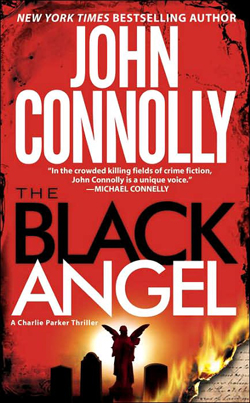 By the fifth book in the Charlie Parker series, The Black Angel, it’s pretty clear that there’s a supernatural element to the books that the characters aren’t imagining. By that time, however, even those who don’t consider themselves fans of horror or the woo-woo are probably too deeply involved in the life and times of Charlie Parker to let go. After all, not only has Connolly given Parker a great history and personality, he’s surrounded him with some of the best sidekicks ever written: Angel and Louis. Anyone who thinks the “gay sidekick” is only good for chick lit has never picked up a Connolly novel. Louis is the consummate killer, and Angel grounds him perfectly, even when their relationship is rocky.
A couple of passages from The Whisperers will serve to illustrate Connolly’s deft hand with description, both of places and of people:
The Palace was the oldest diner car in Maine, custom-built by the Pollard Company of Lowell, Massachusetts, its red and white paintwork still fresh and spruce, and the gold lettering on the window that confirmed ladies were, indeed, invited glowed brightly as though written in fire. The diner had opened for business in 1927, and since then five people had owned it, of whom Kyle was the latest. It served only breakfast, and closed before midday, and was one of those small treasures that made daily life a little more bearable.
[or]
Jackie’s mother regarded the new arrival as unwanted competition for her son’s affections, and had recently begun to play the frail, aging, “Who-will-look-after-me-when-you’re-gone?” role, one into which she did not easily fit as there were great white sharks less well equipped for the solitary life than Mrs. Garner.
There are people who disagree with my assessment of Connolly’s writing, who find his digressions into history too long, too drawn out, too distracting from the main thrust of the plot. I find them fascinating. They always tie in somehow, whether it’s the plot or the theme, and they deepen my enjoyment of the novels.
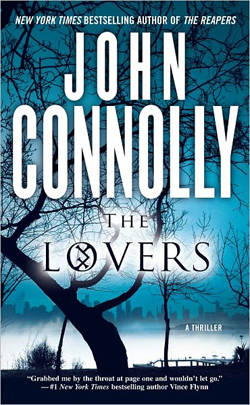 If you were not a hundred percent certain of the supernatural elements in the series beforehand, the eighth book in the Charlie Parker series, The Lovers, makes them absolutely explicit, giving us some of Parker’s ancestry, of his family’s long-term involvement in the battle between good and evil. Oddly enough, it is in this book that Parker decides to rid himself of the ghosts that have haunted him. And if ever there were a passage that calls to you and cries out that genre fiction is as good and as powerful as any in so-called “Lit Fic,” it is this:
Perhaps that was why they came back, or did I still believe that they had never quite departed to begin with? I had set them free, these ghosts of my wife and child. I had asked their forgiveness for my failings, and I had taken all that I had retained of their lives—clothes and toys, dresses and shoes—and burned them in my yard. I had felt them leave, following the marsh streams into the waiting sea beyond, and when I set foot in the house again, the smell of smoke and lost things thick upon me, it seemed different to me: lighter, somehow, as though a little of the clutter had been cleared from it, or an old, stale odor banished by the breezes through open windows.
They were my ghosts, of course. I had created them, in my way. I had given form to them, making my anger and grief and loss their own, so that they became to me hostile things, with all that I had once loved about them gone, and all that I hated about myself filling the void. And they took that shape and accepted it, because it was their way to return to this world, my world. They were not ready to slip into the shadows of memory, to become like dreams, to relinquish their place in this life.
And I did not understand why.
But that was not them. That was not the wife I had loved, however poorly, and the daughter I had once cherished. I had caught glimpses of them as they truly were, before I allowed them to be transformed. I saw my dead wife leading the ghost of a boy into a deep forest, his small hand in hers, and I knew that he felt no fear of her. She was the Summer Lady, taking him to those whom he had lost, accompanying him on his last journey through the thickets and trees. And so that he would not be frightened, so that he would not be alone, there was another with him, a girl close to his own age who skipped in winter sunlight as she waited for her playmate to arrive.
This was my wife and child. This was their true form. What I released in smoke and flames were my ghosts. What returned with the mist were their own.
I cannot stress enough how good these books are. Yes, they’re brutal. They’re hard to read at times. But, ultimately there’s always a spark of hope that—along with the fabulous writing and excellent plots and characters—keeps me coming back again and again.
by Laura K. Curtis | Dec 7, 2012 | Books, Movies, Romance |
This is a post I wrote about two years ago for Heroes and Heartbreakers.
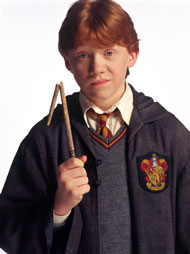 What defines a romantic hero? Does he have to be sexy? Strong? The most important man in the room? Or can he merely be “the one who gets the girl”? If a story has a strong, intelligent heroine, do readers—or viewers in the case of movies—just go along with the heroine’s choice of hero? If you consider the Harry Pottermovies fantasy or adventure, Harry is the hero. But if you consider the cycle a romance, it is Ron who steals the focus.
More than any factor that defines a romantic hero, after all, is that he is brought closer to the heroine by the arc of the story. He may start out less than worthy, but he grows to deserve her. He may not believe he cares about anything or anyone, but by the end she is the center of his world.
Harry never changes. He is loyal, intelligent, caring, and an exceptionally talented wizard right from the start. He is destined for greatness. Interestingly, these are the kind of characteristics one finds in Medieval romances, which are not “romances” in the modern sense, but stories of adventure. If we switch to the modern “boy meets girl” definition of a romance, however, Harry doesn’t fulfill the requirements for a hero.
At the beginning of the cycle, we meet Harry, Ron, and Hermione in quick succession. (Because I’ve recently refreshed myself with the movies in anticipation of the finale, I am going to refer to the movies here rather than the books.) In true romantic fashion, Hermione takes one look at Ron and dismisses him as useless. After all, he messes up a simple spell, something she would never do. She is far more impressed with Harry.
This is a standard genre convention, one so common as to border on cliché: frequently, the hero and heroine dislike each other for any number of reasons at the beginning of a romance. Part of the thrill is watching them figure out they were meant for each other. Shortly after they meet on the train, and after Hermione once again proves her superiority in the field of magic, Ron remarks to Harry that Hermione is weird and has no friends. This completes the founding trope: now she has dismissed him and he has hurt her feelings. Any romance reader immediately recognizes these cues.
It is tempting to go straight to the end of the series to view Ron in his heroic phase, but such extremes are completely unnecessary. Even at the end of the first movie, Ron sacrifices himself in the game of Wizard’s Chess to save the others. And when he does, Hermione stays behind to help him, letting Harry go on alone.
Another convention of romance is the strength of the hero’s family ties. Romantic heroes without families often belong to pseudo-familial communities like paramilitary groups, military units, or tight-knit small towns. In their interactions with these groups, protagonists can show off their heroism without, well, showing off. Both Harry and Hermione are singularly lacking in family—Harry’s parents are dead and Hermione’s are muggles and rarely discussed. Ron’s family is the important one. For all intents and purposes, they adopt both Harry and Hermione. The bond Ron shares with his brothers and his parents is key to seeing that he is good husband and father material.
(It should be noted at this point that another typical feature of the family-oriented romance is a secondary romance featuring some other member of the hero’s family or community. In this case, that honor belongs to Ginny Weasley and Harry. Harry saves her in the Chamber of Secrets, and they end up together, though we don’t see much of the romance’s progression.)
Ron’s heroism is also displayed in his willingness to undertake even those adventures he most fears when his friends ask it of him. Harry and Hermione venture bravely forth into the unknown, often finding themselves overwhelmed and in trouble. Ron, on the other hand, only reluctantly ventures out of his safety zone. Although his terror at first glance lowers our opinion of him, he rises to every occasion and never fails his friends. This is far more impressive than a person whose single-minded focus on a goal allows them to ignore their fears.
And, finally, there are the outwardly romantic aspects of Ron’s journey. He gets involved with a ridiculous girl who makes his life miserable, which leads to Hermione’s first open admission of love. Still, if we are to consider the whole cycle a romance, the couple cannot end up together until the very end. If the couple resolves their differences too early, the end of the story becomes pointless and dragging. So even after Ron ditches the dreadful Lavender Brown, he and Hermione still have hurdles to overcome.
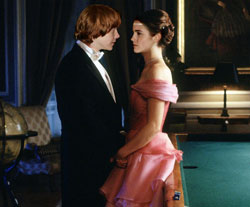 Not the least of these obstacles is Ron’s own feeling of inferiority. This becomes clear in Deathly Hallows, when he storms out of their tent in the woods, leaving Harry and Hermione alone. He is jealous of their relationship, frustrated by his own inability to talk to Hermione about his feelings, and he feels useless in their quest. He returns, however, just when the others need him most, and he is brought back to them by the sound of Hermione’s voice calling to him over the miles.
Ron and Hermione fight together at the end of Deathly Hallows.Together, they retrieve the basilisk fangs needed to destroy the cup Horcrux. When Ron suggests warning the House elves, his selfless impulse and the growing maturity and compassion it evinces allow Hermione to admit her own feelings without reserve.
When we first meet Ron, there is no character who seems less likely to be a romantic hero. Yet, as time goes on, it becomes increasingly evident that Ron Weasley, however unlikely, is the hero of the Harry Potter romance cycle. Not only does he fulfill all the requirements, but in the end, as all good heroes do, he gets the girl.