by Laura K. Curtis | Dec 2, 2014 | Books, Stuff! |
So loads of people are saying “buy my book, it would be a great present.” And many of them are probably right. But in case you are in search of something a little different, here’s a list of things that might strike a chord with the creative types of all ages in your life. The links go to Amazon (because I have an affiliate account), but I encourage you to buy from your local independent, especially since the vast majority of these books need to be paper, not e.


One of the coolest things about this is that the guy who created it also has a website on which you can get a PDF of the book, so if you want to print out the drawings over and over to color in depending on your mood (or if you have multiple children or want to use them as a party game), you can do that, too.


I freaking love this book! The pictures are gorgeous, the coloring is fun and there’s a “can you find it” game, too, with caterpillars and suchlike. And a little garden maze, too. Perfect for young and old.

One of the more entertaining “unleash your creativity” journals with exercises, prompts, etc. (Also would be fun for those looking for a way to blog more often–scan and upload what you do in the journal each day!)

 You know I couldn’t leave a book about crochet off the list, right? Especially when it’s called the Happy Hooker. For anyone looking for a new hobby, I highly recommend crochet. Versatile, easy, and they’ll let you take a hook lots of places you can’t take knitting needles (airplanes, jury rooms…) If you have problems learning from books, I highly recommend YouTube. It’s great how many free tutorials there are out there nowadays!


The Flavor Thesaurus is not a cookbook, but if you know someone who’s a real foodie and loves to cook, it might make an unusual and appreciated present. It explains what flavors go together and why, and it’s just delicious reading.


Try something new! This workbook will help you learn to draw manga-style characters.
So there you go. A few books for you or another creative type in your life. I’d love to hear your suggestions if you have any!!
by Laura K. Curtis | Nov 29, 2014 | Books, Stuff! |
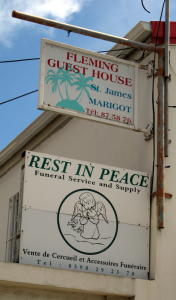 My husband and I spent last week in St. Martin, where my next book (Echoes, coming March 2015) is set. If you live in New York, it’s ridiculously easy to travel to St. Martin, a half-French, half-Dutch island in the Caribbean. My parents bought a timeshare there when I was in my teens, which gives you an idea just how long I’ve been vacationing there. It was only natural that one day I’d end up setting a novel on the island, especially with all the interesting stories I’ve heard from folks I’ve gotten to know over the years who live there. (No, none of them involved serial murder or even individual murder, but I did get to know some really fun stuff about both French and Dutch law. And I am chock full of amusing tales about hotels and the people who stay in them.)
The island’s main industry is, naturally, tourism. Because of that, every available space is used to house tourists, feed tourists, guide tourists, and you get places like Jeffrey’s Auto Parts and Fantastic Guest House and Car Rental. Or a guest house and funeral home in the same building. Or a spot called “Skanki’s Bar.” I can’t imagine seeing any of those at home.
The book is already in the hands of my eminently capable editor, and that’s a good thing. Because otherwise I’d have spent my vacation trying to stuff more (probably irrelevant) fun island stuff into the story!
by Laura K. Curtis | Nov 20, 2014 | Books, Crafts, Freebies & Giveaways, Stuff! |
If you’re in the Boston area, I hope you’ll come visit me and a whole lot of other folks on December 6 at Penny Watson’s Holiday Book Fair, Craft Fair, Cocktail Party, and All-Around Bad-Ass Bash. (OK, that’s a slight exaggeration of the title, but it’s how I think of it in my head.)

by Laura K. Curtis | Nov 11, 2014 | Books, Freebies & Giveaways, Writing |
 Several years ago, I was part of a charity anthology. (You can still buy it on Amazon—Feeding Kate—the profits go to the Lupus Foundation of America. Click the picture at right to see all the fabulous authors who contributed!) The original intent of the anthology was to help a friend of the crime-writing community get jaw surgery she needed that was not being covered by insurance, so many of them were food-related.
The story I contributed was called the Jaws of Life. It’s not about food. But I’ve now put it up for free here on the site in case you are interested in checking it out. It’s right here: The Jaws of Life. Enjoy!
by Laura K. Curtis | Oct 22, 2014 | Books, Romance, Writing |

Back when I was writing cozy mysteries, my favorite conferences were Sleuthfest and Crimebake. Since I became part of the romance community, however, I’ve attended chapter meetings (very local) and national conferences, with nothing in between. National conferences are so expensive that I really had a hard time justifying the financial outlay for anything else. But for a few years, I’d been hearing about the New Jersey Romance Writers “Put Your Heart in a Book” conference and I’d always intended to go when I could.
And then I got really lucky—I’d submitted a proposal for a workshop on branding and it was accepted! I didn’t have to pay the conference fee! I could go!
I live less than two hours away from Iselin, where the conference was held, and I am under deadline, so I decided to drive home rather than spending Saturday night, but I understand the party was hopping!
Anyway, with the national conference in 2015 being in New York, I have a feeling some people will say “why bother with NJ?” Well, having been to both, I figured I’d write a post on that now, while NJ is still fresh on my mind. Here are some reasons to think about NJ next year:
- Cost: I’m not saying you should necessarily judge what conferences you attend based on price, but face it, most of us have to consider our finances!
- Access: This has a couple of meanings. First, because the conference is just a train ride from NYC, you get access to some great agents and editors. I wasn’t looking for either myself, but I had a lovely conversation with a couple of Harlequin editors at lunch. Second, because the conference is slightly smaller, you have more access to the people who are there. I had a fabulous chat with Madeline Hunter, which I cannot imagine happening at nationals where everyone is running around like a lunatic.
- Democracy: This is sort of related to “access” I love Nationals, and I’ve said—repeatedly—that I think people should go to them if they can. However, huge conferences are often where authors who are friends online see each other for the one and only time all year. They are also places where people are somewhat desperate for networking (see my post on Conference Tiffs and the Polite Lie). Because there are fewer people, it’s easier to chat with people, especially those you might be nervous about approaching otherwise. (Like Madeline Hunter. OMG. Madeline Hunter.)
- Accessibility: This is an odd thing to notice unless you’re trained to pay attention to it, but one of the things I can appreciate about the Renaissance Woodbridge, where the NJRW conference is held, is that it’s very accessible. There are guest bedrooms on the main floor, which makes it easier to get to a lot of the events if you have mobility issues. (Not all events are on the same floor, but most are on the main floor.) The hallways are wide, so even if the “goody area” has table set up on both sides for people to put their stuff, there’s still room to maneuver a wheelchair through. And most of the sessions were in rooms that had plenty of egress and aisle space (which are things I notice now that I’m married to a firefighter).
- Talent Pool: one of the reasons I like going to conferences is that I come home re-energized to write and to put into practice all the stuff I’ve heard. Obviously, national conferences have even more people available to them, but I was very impressed with the level of workshop at NJRW. Possibly because the conference has been around a long time and it’s well-known and respected, so they get good speakers.
- Book Fair. I don’t know too many other conferences that have this and make it available to self-published authors. Book fairs are real problems for those of us who already have way too many books, but I can’t ever resist them! Running around, seeing all the good stuff people have out, finding new authors…so much fun! Making friends with the people on either side of you if you’re selling books…priceless.
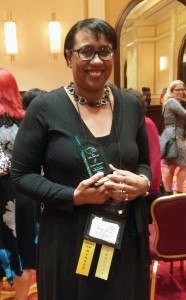
K.M. Jackson with her Golden Leaf Award
For myself, I really enjoyed meeting people after my own workshop and I appreciated that they took the time to come and talk to me and tell me their thoughts. There were a couple of panels I really wanted to get to but missed anyway (it always happens), but the ones I did get to were high quality. I got to spend time with people I’d met once or twice but never really sat down with, and met others who I hope I will be able to continue a relationship with in the future. I connected with one author who writes romantic suspense and we talked at length about doing some co-promotion. Again, something that doesn’t happen when people are frenetically rushing from one event to another.
Of course, I had an especially good time because my friend K.M. Jackson won the Golden Leaf award for her novel Bounce. Lots of joy and happy tears! That always makes a conference better.
All in all, I’d highly recommend this conference. Even if you’re planning on going to nationals in NYC. If at all possible, I’ll be at both!
by Laura K. Curtis | Oct 7, 2014 | Books, Writing |
Several things came together this week—the continuing uproar over the Authors United letters and/or the Amazon-Hachette issues along with Ellora’s Cave suing Dear Author—to create this post. I have many, many things to say about this, so the post is apt to be rambling and a little harsh, so I’ve illustrated it to make it a little more entertaining. And I won’t blame you if you abandon it in the middle going:

OK, got your coffee?
First, the Ellora’s Cave issue since it’s the one that got me started thinking of this post. A week or so ago, publisher Ellora’s Cave filed suit against blogger Jane Litte and her blog, Dear Author. Most of the reactions I saw were along the lines of “OMGWTFBBQ”, but several self-published authors also came out and said, if not in so many words, about the suffering Ellora’s Cave authors, “nah nah, now I bet you’re sorry you didn’t self-publish.”
This seems incredibly, unbelievably short-sighted to me. And it seems short-sighted in the same way as it did when these same authors went “Who gives a damn if Amazon bullies one or all the major publishers out of existence? They deserve it for offering their authors such crappy terms, etc.” And I say this as a self-published author.
Because here’s the thing: unless you’re selling your copies of your self-published book out of the back of your van, you’ve signed contracts with distributors. If you’re smart, you’ve signed contracts with multiple distributors. And I damn sure hope you read all of those contracts. Every last word.

I’m not talking about hitting the highlights of your contract with Kobo or iTunes or B&N or Amazon. Not just “this is how much I make per copy sold” but “this is what I am allowed to do and when I am allowed to do it.” Being self-published doesn’t mean being independent. In fact, unless you’re selling all your books directly off your own website, you’re highly dependent and you need to know what you’ve agreed to do or not do. Your contract with your book’s distributor is not like the latest upgrade agreement to Microsoft Word. (Does anyone actually read those?)
The Ellora’s Cave lawsuit is about stopping a blogger from discussing news important to the publishing industry. Whether you happen to like that blogger, like that blog, like the authors or the publisher involved, it is vitally important that conversations on topic like this not be stifled. Because as an author, as a producer who creates the content, you’re at the mercy of your distributors. (Yeah, some people can make enough selling direct off their websites or out of the back of their vans. But I’m betting the vast majority of us can’t.) So if you don’t know whether your distributors are fiscally healthy, or sane, or if they give contract terms that are standard in the industry, you don’t know what you should sign. And that matters whether you’re traditionally published, self-published, or anything in between.
And your distributor contracts may change during the course of your career, so you can’t just sign and forget about them, either. You may not be interested in Ellora’s Cave, but if EC should win that lawsuit (highly unlikely, IMHO), other sites will be less interested in exposing failures of other distributors. Since you read your contract with your distributor, you saw the part where it says that they can change the terms when they like, right? Well, when those changes happen, you read the information they send you about it, but what if you don’t understand it exactly? If publisher-agnostic sites are frightened to speak up because of lawsuits, where do you go for help?
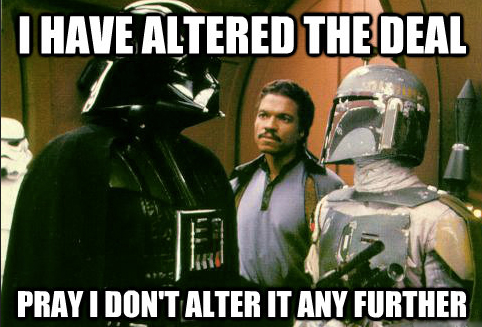 Now, of course, you have the right to pull your books out of distribution if you don’t like what what your distributor wants to do, but that’s about the only card you hold. Which is basically what’s going on with Hachette and Amazon right now. Amazon wants something and Hachette wants something else. It’s as simple, and as complex, as that. Stop for a minute and consider this: Hachette has thousands of authors, millions of dollars tied up in Amazon and they can’t get any traction in a negotiation. Do you think you will be able to if you decide you’d like to alter your deal?
I’m not a big fan of the Authors United approach. Their letter to Amazon’s board smacks of egoism and “special snowflake syndrome.” But I am even less a fan of monopsonies. I have said before that it is my absolute belief that if Amazon controls the book market, everyone—including self-publishers—will suffer. Why? Because it is not in the nature of corporations to offer favorable terms unless they absolutely have to.
This is essentially what happened with Audible—once Amazon/Audible controlled the audiobook market, they cut the royalties they gave producers/authors in half. Once they have the market, why should they pay more? And if they cut royalties, chances are authors will raise their book prices to make up some of what they lose. Which means consumer prices go up.
A competitive marketplace, with multiple distributors and lots of clarity and openness, where people are allowed to speak their mind and discuss the details of their contracts and sales, benefits everyone. It doesn’t matter whether you’re a writer or a reader. Anything that stifles discussion or creates monopolies or monopsonies should be fought tooth and nail, no matter what your publishing path may be.