by Laura K. Curtis | Feb 15, 2015 | Movies |
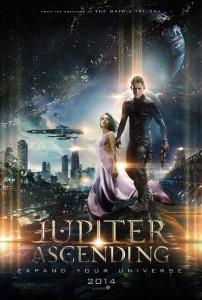 While the talk of late has been “don’t bash 50 Shades or moviemakers won’t make love stories,” people seem to be missing the big screen love story that’s not about a stalkery billionaire and his red room of pain. Reviews tend to focus on the fact that the Cinderella story of Jupiter Jones doesn’t quite work out—she starts out scrubbing toilets and she’s still scrubbing toilets at the end.
But the problem with these reviews is that Jupiter Ascending isn’t a fairy tale. It isn’t supposed to end with the heroine marrying well and never having to do a lick of work. No, Jupiter Ascending is a genre romance, and for that there has to be an ending where the heroine does something worthwhile and her lover enhances her life in significant ways but does not remove her from it. She is an active participant in her own life, making decisions and sacrifices, growing and changing. In a romance, it is not necessary that she stop cleaning toilets for a living; what has to happen is that her life has to improve in some fashion and that improvement has to be precipitated by the presence of the hero.
In Jupiter Ascending, it is Caine who literally transforms, and whose daily life undergoes a massive change. Jupiter’s alterations are quieter, not so visible, but just as fundamental. As in all good romances, both grow and learn to find satisfaction in their lives, satisfaction that would not be possible without the other’s presence.
Yes, it was glowing and glitzy and chock full of crazy. Yes, there were plot holes. Yes, you can pick it apart with relative ease if you think about it too hard. But at heart it’s a lovely, romantic story with the trappings of sci-fi.
by Laura K. Curtis | Dec 26, 2013 | Movies, Stuff! |
I don’t know about you guys, but for me the holidays are like a vacation–when they’re over, I need a vacation! This year I had great fun with my nieces and nephews (and my siblings and parents, of course, but it’s really about the kids. It’s amazing to me how much they change from year to year. I have three nieces and three nephews ranging in age from about 5 to 13. They are each immensely different from one another and each wonderful in his or her own right, but keeping up with them is quite a lot for these old bones.
As is feeding them. If you’re a regular reader of this blog you know that I am allergic to gluten. My niece is a vegetarian. But we do the whole turkey-n-trimmings thing for Christmas, so that’s a bit of a problem. Here are some things we found this year as accommodations:
 Williams-Sonoma’s turkey gravy base has no gluten. It’s thickened with cornstarch and it’s pretty tasty. Add drippings from your own turkey.
If you’re making string beans amandine, try sauteing the almonds with finely diced shallots. Makes them extra delicious.
Super easy and delicious if you’re trying to add a few more veggies to the menu: Martha Stewart’s Roasted Carrots, Parsnips, and Shallots. Conveniently, this cooks on a baking pan at 450°, so it can go into the oven while you’re making your turkey, most likely. It calls for olive oil, but we prefer to use Rick Bayless’s Garlic Mojo. We always keep it in the house. There is no substitute.
On the gluten free front, let me just mention that there is only one really, really good gluten-free cornbread mix on the market: Jules Gluten Free. I used it to make cornbread dressing this year and it was awesome!
I hope your winter holidays, if you celebrate any, have been fabulous, and that 2014 brings all good things!
by Laura K. Curtis | Jan 13, 2013 | Movies, Stuff! |
 Two pieces of news for the Star Wars geeks among us (like yours truly).
First, as you may or may not know, the White House was petitioned to “secure resources and funding, and begin construction of a Death Star by 2016” through the We The People site. The petition gathered enough signatures to require a response and earlier this week Paul Shawcross, Chief of the Science and Space Branch at the White House Office of Management and Budget, wrote the most amazing response…ever.
The awesomeness begins with the response’s title: This Isn’t the Petition Response You’re Looking For. And it just gets better. You should read the whole thing, but the top reasons Shawcross gives are:
- The construction of the Death Star has been estimated to cost more than $850,000,000,000,000,000. We’re working hard to reduce the deficit, not expand it.
- The Administration does not support blowing up planets.
- Why would we spend countless taxpayer dollars on a Death Star with a fundamental flaw that can be exploited by a one-man starship?
And then there is the rumor, according to Entertainment Weekly, that:
ABC entertainment president Paul Lee says he’s going to take a look at the long-gestating Star Wars live-action TV series now that the Disney deal to acquire Lucasfilm is complete.
“We’d love to do something with Lucasfilm, we’re not sure what yet,” Lee exclusively told EW. “We haven’t even sat down with them. We’re going to look at [the live-action series], we’re going to look at all of them, and see what’s right. We weren’t able to discuss this with them until [the acquisition] closed and it just closed. It’s definitely going to be part of the conversation.”
As usual, the thought of such a thing is both marvelous and terrible. I mean, the first three movies were so great and the second were so…not. The EW article sounds promising—series to be set in the seedy underworld of the Empire between the two series with a bounty hunter as the lead character. Lots of potential. But we’ve seen both Disney and Lucasfilm squander potential in the past.
So it’s been a fun week for Star Wars fans all the way around!
by Laura K. Curtis | Dec 7, 2012 | Books, Movies, Romance |
This is a post I wrote about two years ago for Heroes and Heartbreakers.
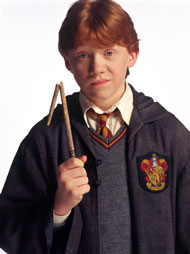 What defines a romantic hero? Does he have to be sexy? Strong? The most important man in the room? Or can he merely be “the one who gets the girl”? If a story has a strong, intelligent heroine, do readers—or viewers in the case of movies—just go along with the heroine’s choice of hero? If you consider the Harry Pottermovies fantasy or adventure, Harry is the hero. But if you consider the cycle a romance, it is Ron who steals the focus.
More than any factor that defines a romantic hero, after all, is that he is brought closer to the heroine by the arc of the story. He may start out less than worthy, but he grows to deserve her. He may not believe he cares about anything or anyone, but by the end she is the center of his world.
Harry never changes. He is loyal, intelligent, caring, and an exceptionally talented wizard right from the start. He is destined for greatness. Interestingly, these are the kind of characteristics one finds in Medieval romances, which are not “romances” in the modern sense, but stories of adventure. If we switch to the modern “boy meets girl” definition of a romance, however, Harry doesn’t fulfill the requirements for a hero.
At the beginning of the cycle, we meet Harry, Ron, and Hermione in quick succession. (Because I’ve recently refreshed myself with the movies in anticipation of the finale, I am going to refer to the movies here rather than the books.) In true romantic fashion, Hermione takes one look at Ron and dismisses him as useless. After all, he messes up a simple spell, something she would never do. She is far more impressed with Harry.
This is a standard genre convention, one so common as to border on cliché: frequently, the hero and heroine dislike each other for any number of reasons at the beginning of a romance. Part of the thrill is watching them figure out they were meant for each other. Shortly after they meet on the train, and after Hermione once again proves her superiority in the field of magic, Ron remarks to Harry that Hermione is weird and has no friends. This completes the founding trope: now she has dismissed him and he has hurt her feelings. Any romance reader immediately recognizes these cues.
It is tempting to go straight to the end of the series to view Ron in his heroic phase, but such extremes are completely unnecessary. Even at the end of the first movie, Ron sacrifices himself in the game of Wizard’s Chess to save the others. And when he does, Hermione stays behind to help him, letting Harry go on alone.
Another convention of romance is the strength of the hero’s family ties. Romantic heroes without families often belong to pseudo-familial communities like paramilitary groups, military units, or tight-knit small towns. In their interactions with these groups, protagonists can show off their heroism without, well, showing off. Both Harry and Hermione are singularly lacking in family—Harry’s parents are dead and Hermione’s are muggles and rarely discussed. Ron’s family is the important one. For all intents and purposes, they adopt both Harry and Hermione. The bond Ron shares with his brothers and his parents is key to seeing that he is good husband and father material.
(It should be noted at this point that another typical feature of the family-oriented romance is a secondary romance featuring some other member of the hero’s family or community. In this case, that honor belongs to Ginny Weasley and Harry. Harry saves her in the Chamber of Secrets, and they end up together, though we don’t see much of the romance’s progression.)
Ron’s heroism is also displayed in his willingness to undertake even those adventures he most fears when his friends ask it of him. Harry and Hermione venture bravely forth into the unknown, often finding themselves overwhelmed and in trouble. Ron, on the other hand, only reluctantly ventures out of his safety zone. Although his terror at first glance lowers our opinion of him, he rises to every occasion and never fails his friends. This is far more impressive than a person whose single-minded focus on a goal allows them to ignore their fears.
And, finally, there are the outwardly romantic aspects of Ron’s journey. He gets involved with a ridiculous girl who makes his life miserable, which leads to Hermione’s first open admission of love. Still, if we are to consider the whole cycle a romance, the couple cannot end up together until the very end. If the couple resolves their differences too early, the end of the story becomes pointless and dragging. So even after Ron ditches the dreadful Lavender Brown, he and Hermione still have hurdles to overcome.
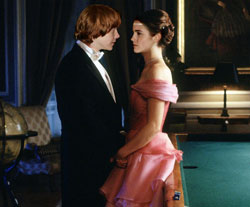 Not the least of these obstacles is Ron’s own feeling of inferiority. This becomes clear in Deathly Hallows, when he storms out of their tent in the woods, leaving Harry and Hermione alone. He is jealous of their relationship, frustrated by his own inability to talk to Hermione about his feelings, and he feels useless in their quest. He returns, however, just when the others need him most, and he is brought back to them by the sound of Hermione’s voice calling to him over the miles.
Ron and Hermione fight together at the end of Deathly Hallows.Together, they retrieve the basilisk fangs needed to destroy the cup Horcrux. When Ron suggests warning the House elves, his selfless impulse and the growing maturity and compassion it evinces allow Hermione to admit her own feelings without reserve.
When we first meet Ron, there is no character who seems less likely to be a romantic hero. Yet, as time goes on, it becomes increasingly evident that Ron Weasley, however unlikely, is the hero of the Harry Potter romance cycle. Not only does he fulfill all the requirements, but in the end, as all good heroes do, he gets the girl.
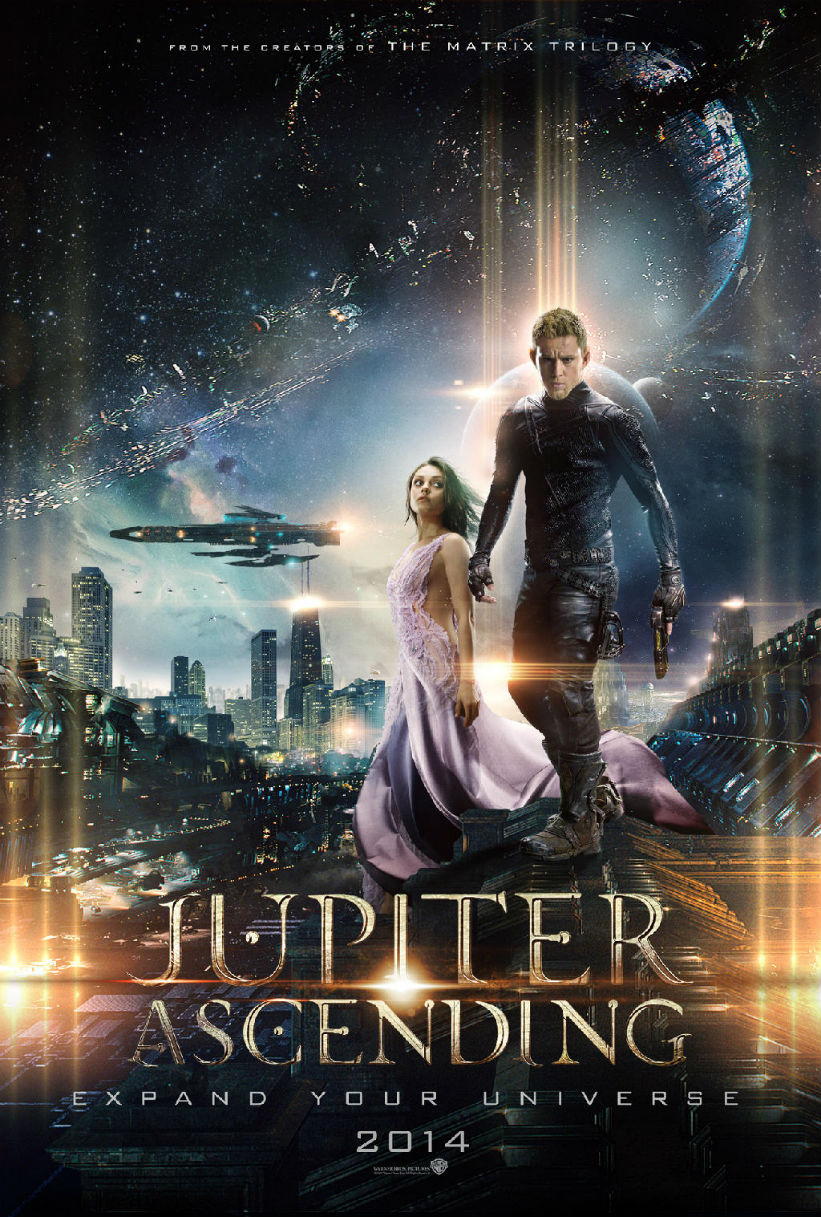 While the talk of late has been “don’t bash 50 Shades or moviemakers won’t make love stories,” people seem to be missing the big screen love story that’s not about a stalkery billionaire and his red room of pain. Reviews tend to focus on the fact that the Cinderella story of Jupiter Jones doesn’t quite work out—she starts out scrubbing toilets and she’s still scrubbing toilets at the end.