by Laura K. Curtis | Jul 7, 2015 | Books, Romance |
 Warning: TL;DR post filled with questions without answers ahead.
Romancelandia is fond of self-examination and since I come from an academic background, I often find discussions of what books are or are not capable of fascinating. When Fifty Shades came out, and to a lesser extent when it’s predecessor Twilight was released, there was a huge uproar about the glorification of stalking and abuse. “You’re giving women terrible ideas of what a good relationship should look like,” people screamed.
And I was one of those people. (Though I like to think I kept my statements to a dull roar.)
When I was in college, I dated a man who was emotionally abusive. Never physically abusive in ways that showed, he did enjoy hurting me in small ways, embarrassing me in public, and generally making me feel stupid. As a result, those are all huge, massive triggers for me. Nothing will make me abandon a book faster than a hero who does that to anyone, not just to the heroine.
So when people started talking about how “romantic” Christian Grey was, I begged to differ. To me, he was a creepy, stalking abuser who carefully separated the object of his obsession from her support system.
But this is not about Grey. It’s about two arguments I hear in the world of romance with regularity and how they are simultaneously true and not true. I believe (and this being the Internet, if I am wrong, someone will correct me instantly) it was Kierkegaard who originally discussed the human ability to believe two contradictory things at the same time. As regards romance, those two things seem to be
1) Fiction can influence your view of yourself and the world
2) Fiction cannot influence your view of yourself or the world
Instinctively, I lean toward the belief that it can, and does. And yet, whenever I hear someone (usually a man) say “romance gives women unrealistically high expectations for relationships” I think to myself, “well, that’s a crock.” Because I don’t believe that. Not for a minute.
And when people ask why I am so sure that it’s not true, I say it’s because the people reading romance know they’re reading fantasy, the same way people reading thrillers know they’re reading fantasy. You don’t really believe people live the way Jack Reacher does, do you?
But if that is true, if all those people understand that they are reading fantasy, then why should we even bother to talk about the glorification of patently unhealthy behaviors and relationships? Go read what you enjoy and be done with it. It can’t possibly have any influence over anyone.
(Of course, some people don’t know the difference between fiction and reality, a fact that the marketing firms for books like The DaVinci Code and FSOG capitalize on. But those people aren’t the ones I am talking about. Those people have other problems.)
And yet, I’ve heard any number of people say that they learned about healthy relationships from reading romance, and when I read those articles I think “yes, that’s spot on. Reading a story can show you you’re worth something.”
And I believe many, many people need reminding of their own value. People you’d look at and think “oh, she has it all. She’s filled with self-confidence.”
I am absolutely sure that most people thought my college relationship was great. In fact, several of my friends told me they were jealous. I did not have any objective reason to put up with the crap I put up with from that man. I had no weak female role models. Anyone who knows my family knows that. My grandmother divorced four husbands because they could not keep up with her. I had had a solid, strong relationship before that one with a man who respected me. I was not the person you would ever have thought would end up with an alphahole. When I got out of that relationship, it took me a long, long time to trust my own judgment enough to get into another.
I started making rules. “Thou shalt not date a man who…”. And right up at the top was “a man who denigrates you in front of his friends.” It was the first time I consciously started to defend my own worth.
 The books I write are filled with people—both men and women—learning their own value. And to me, some of the most satisfying books to read are those in which the characters discover their worth. Perhaps that story works so well for me because I know if I don’t keep reading it I might forget.
In college, I was heavily invested in epic fantasy, which is filled with relationships—good and bad, healthy and unhealthy—but I don’t think I took much away from them except for a certain wistful desire for a life away from the one I had. I was a psychology and literature double major and yet I still didn’t didn’t make any connection between reading and life.
After epic fantasy, I moved to historical romance and romantic suspense, two genres utterly removed from the reality of my life. They both provided that same sense of escape I’d gotten from fantasy. And I began to realize that all genre novels were fantasy, no matter how closely they might mimic reality. People didn’t read genre fiction to get a picture of the world.
And that, I guess, is where I land in my debate between “can it or can’t it?” Genre fiction is fantasy, and while fantasy can change a reader’s view of reality in broad strokes—”I deserve to be treated with respect”—readers who understand that they are reading fiction don’t expect to, say, find themselves courted by a vampire…or even a billionaire.
Of course, this doesn’t actually answer the question of whether books have influence, but I didn’t expect to come up with an answer. As the title suggests, this is really a ramble around in my own mind.
But in case you’re still with me, I should point out that regardless of whether people are or are not influenced by the fiction they read, I don’t believe it’s the responsibility of authors to change what they write. Nor do I think we need to consume everything critically. We can consume simply for enjoyment.
I do, however, believe that critical consumption has benefits and I don’t think we do nearly enough of it. I know I don’t. I am always reminding myself to do more, do better. And I think it’s important to listen to the people who are critically consuming the very same things we are consuming for enjoyment. And perhaps that is what makes it so hard for me to reconcile my varied feelings about books as models—I want to have my cake and eat it without thinking about sugar, but I know diabetes lurks around the too-much-cake corner.
by Laura K. Curtis | Oct 22, 2014 | Books, Romance, Writing |

Back when I was writing cozy mysteries, my favorite conferences were Sleuthfest and Crimebake. Since I became part of the romance community, however, I’ve attended chapter meetings (very local) and national conferences, with nothing in between. National conferences are so expensive that I really had a hard time justifying the financial outlay for anything else. But for a few years, I’d been hearing about the New Jersey Romance Writers “Put Your Heart in a Book” conference and I’d always intended to go when I could.
And then I got really lucky—I’d submitted a proposal for a workshop on branding and it was accepted! I didn’t have to pay the conference fee! I could go!
I live less than two hours away from Iselin, where the conference was held, and I am under deadline, so I decided to drive home rather than spending Saturday night, but I understand the party was hopping!
Anyway, with the national conference in 2015 being in New York, I have a feeling some people will say “why bother with NJ?” Well, having been to both, I figured I’d write a post on that now, while NJ is still fresh on my mind. Here are some reasons to think about NJ next year:
- Cost: I’m not saying you should necessarily judge what conferences you attend based on price, but face it, most of us have to consider our finances!
- Access: This has a couple of meanings. First, because the conference is just a train ride from NYC, you get access to some great agents and editors. I wasn’t looking for either myself, but I had a lovely conversation with a couple of Harlequin editors at lunch. Second, because the conference is slightly smaller, you have more access to the people who are there. I had a fabulous chat with Madeline Hunter, which I cannot imagine happening at nationals where everyone is running around like a lunatic.
- Democracy: This is sort of related to “access” I love Nationals, and I’ve said—repeatedly—that I think people should go to them if they can. However, huge conferences are often where authors who are friends online see each other for the one and only time all year. They are also places where people are somewhat desperate for networking (see my post on Conference Tiffs and the Polite Lie). Because there are fewer people, it’s easier to chat with people, especially those you might be nervous about approaching otherwise. (Like Madeline Hunter. OMG. Madeline Hunter.)
- Accessibility: This is an odd thing to notice unless you’re trained to pay attention to it, but one of the things I can appreciate about the Renaissance Woodbridge, where the NJRW conference is held, is that it’s very accessible. There are guest bedrooms on the main floor, which makes it easier to get to a lot of the events if you have mobility issues. (Not all events are on the same floor, but most are on the main floor.) The hallways are wide, so even if the “goody area” has table set up on both sides for people to put their stuff, there’s still room to maneuver a wheelchair through. And most of the sessions were in rooms that had plenty of egress and aisle space (which are things I notice now that I’m married to a firefighter).
- Talent Pool: one of the reasons I like going to conferences is that I come home re-energized to write and to put into practice all the stuff I’ve heard. Obviously, national conferences have even more people available to them, but I was very impressed with the level of workshop at NJRW. Possibly because the conference has been around a long time and it’s well-known and respected, so they get good speakers.
- Book Fair. I don’t know too many other conferences that have this and make it available to self-published authors. Book fairs are real problems for those of us who already have way too many books, but I can’t ever resist them! Running around, seeing all the good stuff people have out, finding new authors…so much fun! Making friends with the people on either side of you if you’re selling books…priceless.
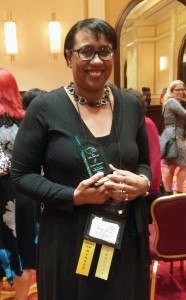
K.M. Jackson with her Golden Leaf Award
For myself, I really enjoyed meeting people after my own workshop and I appreciated that they took the time to come and talk to me and tell me their thoughts. There were a couple of panels I really wanted to get to but missed anyway (it always happens), but the ones I did get to were high quality. I got to spend time with people I’d met once or twice but never really sat down with, and met others who I hope I will be able to continue a relationship with in the future. I connected with one author who writes romantic suspense and we talked at length about doing some co-promotion. Again, something that doesn’t happen when people are frenetically rushing from one event to another.
Of course, I had an especially good time because my friend K.M. Jackson won the Golden Leaf award for her novel Bounce. Lots of joy and happy tears! That always makes a conference better.
All in all, I’d highly recommend this conference. Even if you’re planning on going to nationals in NYC. If at all possible, I’ll be at both!
by Laura K. Curtis | Sep 18, 2014 | Books, Romance, Writing |
So now that I’ve gotten my contract back and it’s all official and everything, I can announce that I have two more books coming from Penguin in April and November of 2015. They’re as yet untitled, but they will be romantic suspense, loosely related to each other and to TWISTED and LOST.
Also, if you’re interested in contemporary romances, I’ll have another one of those next year as well. I’d love to be able to promise you an exact date, but I can’t since it’s self-pub and highly dependent on the schedules of all the great people who help me get the self-pub work to market.
 To celebrate all this fun stuff, I am offering 20% off my contemporary romance in both print and ebook (and the sweet zombie short story I co-wrote) through my Storenvy store. Just click the picture at right and use the coupon code 20BLOG at checkout. This coupon expires October 1 at 6pm Eastern.
by Laura K. Curtis | Aug 28, 2014 | Books, Romance, Writing |
 This topic arose today on Twitter, particularly in the cases of “fated/cursed” lovers. In my first TICA—tropes I cannot abide—post I talked about alpha-holes. My dislike of insta-love isn’t as strong, but it’s still there.
I’m going to deal with the reason I dislike the “fated lovers” trope first because it’s simpler: when something is fated, there’s no escaping it. You can make it more interesting by saying they’re fated to love each other and cursed not be together, but since it’s a romance, I won’t believe the curse part. I know they’ll overcome it. And, most likely since the very concept of fate is paranormal, there will be some kind of magical “intervention” that serves as a deus ex machina, solving the curse. This is a big part of my issue with paranormal romance in general—love is hard in real life, and I prefer romance to be realistic enough to reflect that. (I know, you’re tired of me saying that, too.)
That being said, there’s plenty of insta-love in romance that isn’t fated/cursed. Boy meets girl. They fall in love right away. Events conspire to keep them apart, and the story focus is entirely on how they get back to each other. This can make for an exciting adventure story, but it doesn’t hold up as a romance for me.
Why? Because the point of a romance novel, as opposed to a novel with romantic elements, is the romance arc. If you take care of that in the first ten percent of the book, it’s not a romance. People may say “but don’t you believe in love at first sight?” Well…I believe in potential at first sight. I believe in lust at first sight. I believe in attraction at first sight. But before you know you’re in love with someone, you have to try things out. You have to find the ways in which you are, and are not, compatible. You have to spend time together…or at least have an epistolary or telephonic relationship.
I remember that after the very first time I met my husband I knew I wanted to date him. You might, given the fact that we’re now married, call it “love at first sight.” But I would call it “potential for love” at first sight. I knew we had a chance. The actual love part took longer.
When I read a romance, I want to see that potential becoming a reality. That’s the ride I sign up for when I open a romance novel. If you just say “they’re in love” and go from there, you’re cheating me out of the experience I paid for.
by Laura K. Curtis | Jul 29, 2014 | Books, Romance |
Obviously, I haven’t read any of these yet since they just came out today, but I am going to ahead and say they’re probably pretty darn good!

 Molly O’Keefe, Between the Sheets.
Any of you who read this blog know O’Keefe is a personal favorite. This is the final book in her “Bad Boys of Bishop” trilogy.

 Lisa Jackson, Deserves to Die.
This is the latest in the Alvarez and Pescoli series. I absolutely love this series and the two strong female detectives who star in it.

 Victoria Dahl, Looking for Trouble.
Dahl is back and bringing the heat, this time between a bad boy biker and a naughty librarian!
by Laura K. Curtis | Jul 21, 2014 | Books, Romance |

Westerly, RI — typical small New England beach town.
I love romance of all types, but I must admit a certain fondness for the small town contemporary. However, I occasionally find myself wondering whether the authors of these romances have ever lived in a small town, or whether their definitions of “small town” are just that different from mine.
I grew up in a truly tiny town. We had no addresses. We had no mail delivery. That was primarily a fishing and farming town, at least until they built a big highway to take people there at which point it acquired a vibrant tourist economy. It stayed tiny for 9 months a year, but suddenly became jam-packed every summer.
Now I live in what I would call a medium-sized suburb. The official population of our town is about 11,000, but we have a fair number of undocumented folk living here, so it’s probably a bit higher. We also have a religious community that I am not at all sure how is counted. The town just south of us has 17k people, but far fewer businesses. Likewise the town just north of us, which has 18k people. Despite being the least populated and physically (mileage-wise) smallest, we have the biggest “downtown.” We also have the only area hospital. We have no veterinarian, however–you have to go to the next town north or the next town south for that. But you can do that because, like many small towns, we are surrounded by other small towns that have what we don’t.
The other thing about most small towns in America is that their fire departments are volunteer. Like ours. And that’s where the gossip gets passed. You grow up in town, you join the fire department. Not always, it’s true, but an awful lot of folks do. And if they work for the town, the railroad, or the utility companies, or any kind of blue-collar work that keeps them local, it’s almost inevitable that they belong to the fire department.
 People who have lived in my current town all their lives all know each other. They’ve dated each other, married each other, divorced each other. They’ve been in school together and worked in each others’ businesses. They belong to the fire department, and their wives and sisters belong to the women’s auxiliary. But a large part of this population moved here later on in life, and most of them know nothing about the inner workings of the town. A few of them join the FD, but not many. Although my husband and I are relatively recent additions to the town (we moved here 10 years ago), my husband is in the fire department and I am in the auxiliary, so we tend to know what’s up.
The other recently-arrived belong, for the most part, to the “bedroom community” part of the town and have issues getting home improvements approved (unless they hire entirely locally). They have no idea what businesses are going in or going out or why. Which companies haven’t paid their taxes. Which ones are being investigated. I don’t mean this as a slight—it’s simply the reality of life in my 11k-person-town: the newcomers know the parents of the kids in their kids’ class at school and the parents of the dogs at the dog park. Their focus isn’t here in town, it’s down in “the city”—NYC, that is—where most of them work.
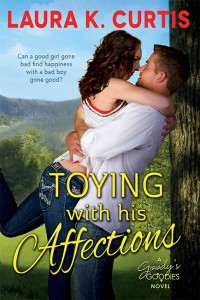 When I wrote Toying With His Affections, my first contemporary romance, I knew that it would read like a lot of other small town contemporaries. I don’t mind that. I enjoy these books or I wouldn’t have written one. But there are aspects I wanted to differently, and one of those was the “everyone’s in your business” aspect. So I gave my protagonist an aunt who’s part of the town’s Ladies’ Auxiliary. I hope you enjoy reading my iteration of that particular type of group!
 Warning: TL;DR post filled with questions without answers ahead.
 The books I write are filled with people—both men and women—learning their own value. And to me, some of the most satisfying books to read are those in which the characters discover their worth. Perhaps that story works so well for me because I know if I don’t keep reading it I might forget.

