by Laura K. Curtis | Sep 2, 2015 | Crafts, Freebies & Giveaways, Prompts 2015, Writing |
 If you follow me on social media, you probably know how obsessed I’ve become with planners and planning. Indeed, some of you may have taken the course I offered at Savvy Authors. So naturally, when Alexandra Haughton mentioned this blog hop, I HAD to jump in. Seriously, what an excellent idea–a bunch of authors all sharing how they get organized! You can find all the different authors on the main hop page.
When I started out as a writer, I had a day job and I just wrote when the words came. I did trade shows as part of my day job, so I ran around a lot, which helped keep me from packing on too many pounds, even though the rest of my work life was pretty sedentary.
And then life changed, as it is wont to do. I gave up the trade show job for an office job. Better money, more security…less exercise. And I sold my first book, which meant I had to write more books. Under contracted deadlines. To contracted lengths. Oh, my. And I decided to self-publish some work. And volunteered to put a story in a charity anthology. And then volunteered to edit and organize another anthology.
I find it easiest to keep all my appointments on my iPhone, but I’ve always written my manuscripts mostly by hand, doing the first edit as the words go from notebooks to the computer, so it only made sense that once I started getting into using a paper planner I would become part of the #planneraddicts society. I have tried pretty much every planner system out there and the one that works for me is the Plum Paper Planner. My new one JUST started this month, so it’s looking rather barren. (Especially since it HADN’T started when I wrote this post in August, so I just stuck some stuff in so you could see how it WILL look.)
Here’s my Plum. Although it divides the day into Morning/Afternoon/Evening, I don’t split mine like that. I keep the earlier blocks for to-dos and appointments and the bottom box for long-term goals like writing and fitness. Next to each little typewriter is the number of words I’ve set as a goal for myself to write that day. The actual word count goes on the paper, and if I make my goal I get a pretty sticker or I decorate with colored markers. Likewise, I am doing PiYo to get myself moving again. So I have stickers to remind me which PiYo workout I am supposed to do each day.

This is what keeps me on track. Now, I do keep appointments in my phone’s calendar and I manage my boss’s Google calendar as part of my day job.Frankly, for appointments, I just find a gadget that will send you a reminder makes sense. But for long term tracking of what I have to do, when I have to do it, etc, I love paper. All the projects for the day job also go in the planner. Besides, all kinds of studies show that writing things down makes them stick in a way that putting things into digital media does not.
Maybe you’ve seen this GIF…I don’t know where it comes from, or I’d add attribution:
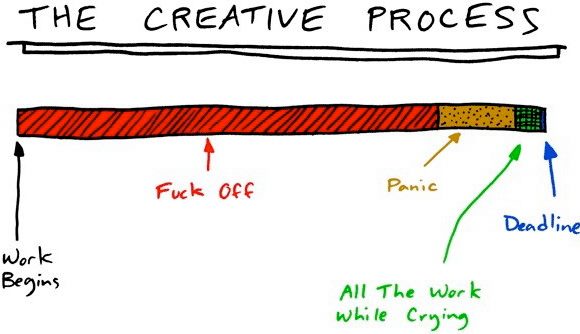
Since I really, really hate the “Panic” stage and I even more hate the “All the Work While Crying” stage, I give myself a certain number of words I need to do each day. But I have learned that I am not good at doing things “for me.” I have to do them for someone else. I will kill myself to be sure I don’t let someone else down. So what that means is that for my current project, I’ve hired an editor and have to have it to her October 16. It’s going to be single title length, so I’ve budgeted myself at 90k words. If I write a few more or a few less, that’s fine, but this is just to give me broad target to hit. My contemporaries used to come in at 65k, so it won’t be the same for every book.
I ONLY PLAN ONE WEEK AT A TIME. Seriously. I can’t stress this enough. If you have any kind of mood disorder, as so many of the writers I know do (my own are OCD and depression), it’s so, so easy to blame yourself when you don’t meet goals. So I try to keep my deadlines reasonable and pad them at the beginning. That way when I screw up, screw off, or otherwise miss a deadline, I can just add more words to the next week, or write on a couple of days I’ve given myself off. (And yes, I schedule days off.)
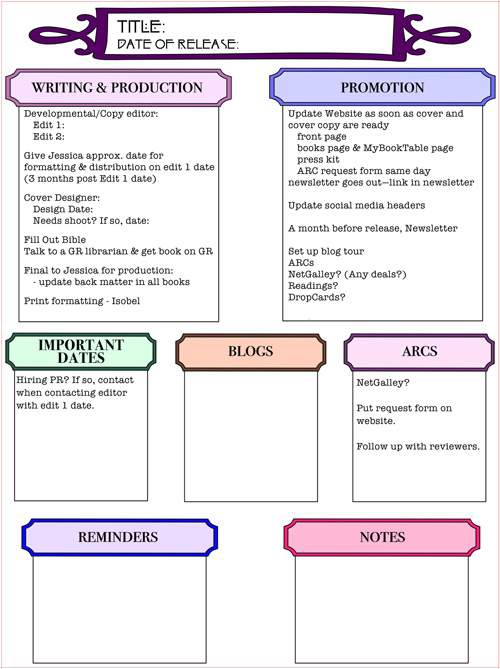
But there are also publicity and marketing deadlines to keep. So for every project, I have a “project sheet,” which was inspired by a number of my Twitter friends in response to my own desperation. It’s laid out in a way I can keep track of it (I think the wonderful Bree Bridges inspired the layout originally) and I can write notes in about what blogs I tried, whether there was reaction, what promotional stuff I did, etc. I laminate the project sheet, punch it to fit into my planner, pop it in the planner, and write on it with sharpies as I go along. I enter dates, comments, etc. (Here’s a nifty tip you may not know: If you write on a laminated sheet with a Sharpie and want to erase, go over it with a dry erase marker, then wipe off!)
I also have a couple of other recommendations for you folks who are trying to organize not just your own days, but your story’s days. Check out this post on Aeon Timeline for tracking time in an individual book or in a series. My current manuscript tracks (*shudder*) nine generations of three intertwined families. Without Aeon, I’d be completely lost.

All the authors participating in the hop are giving away prize packs. There was so much great organizational stuff and so many gift cards and free books offered that the organizers had to divide them into six, that’s right, SIX, separate prizes! There’s a rafflecopter at the bottom of this post, so jump on in and enter!
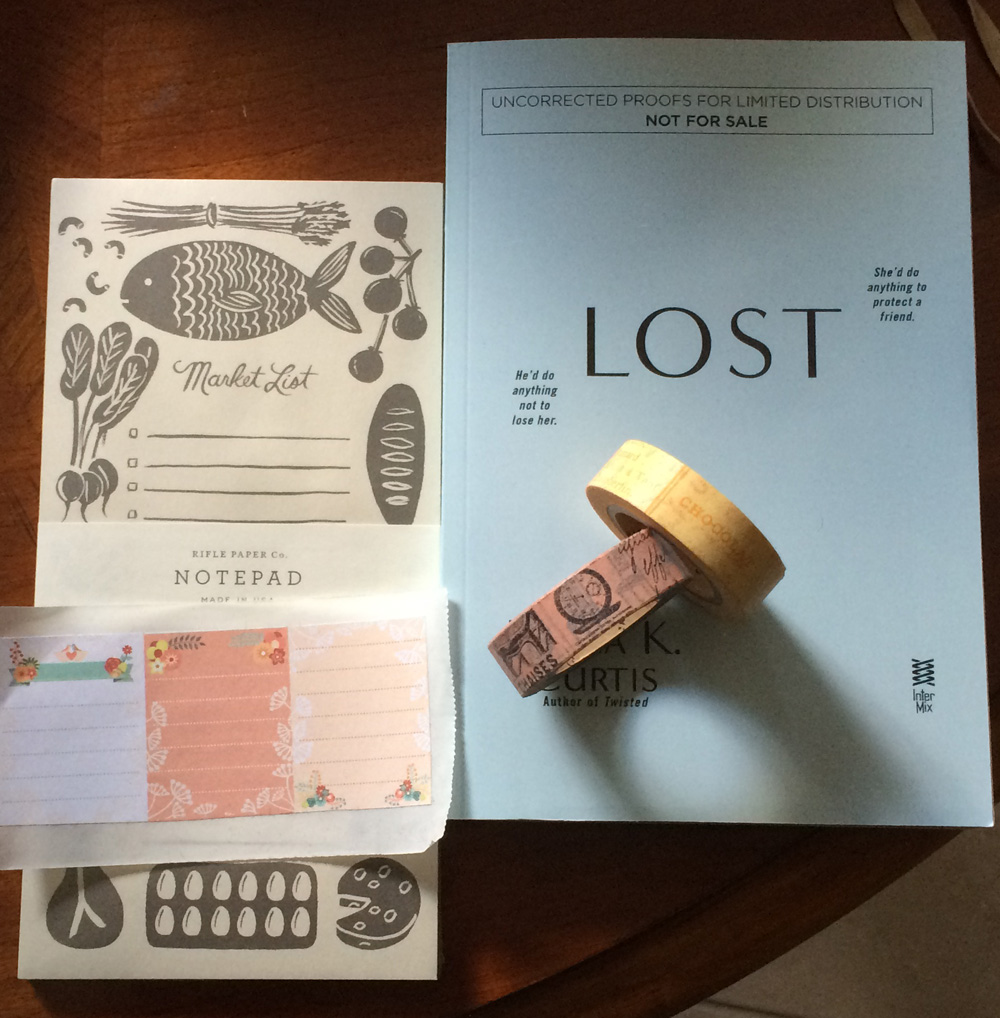
Here’s my prize, which is only PART of ONE of the prizes! Washi, To-Do stickers, a pad, and an ARC of LOST. Enter at the bottom for this and a TON more stuff!
a Rafflecopter giveaway
by Laura K. Curtis | Jul 20, 2015 | Writing |
Recently, I realized I needed a series bible for all my books that involve Harp Security. I’m not sure how many details other authors can cram into their brains without bits and pieces getting confused, but I found that after three books, things were starting to get messy upstairs.
A series bible keeps track of a lot of information, but one thing that a lot of folks find hard to deal with is timelines and I’ve never found a satisfactory way to manage that in either a spreadsheet or in Scrivener, which is where the rest of the character and series information are stored.
Luckily, as the saying goes, there’s an app for that. Aeon Timeline. Honestly, there’s nothing like it that I’ve ever discovered. Here’s the timeline for all the Harp books so far.

Under the timeline itself, you can see various characters or organizations. When you create a new “entity,” you can either give it a start date, or you can set its age at the time of its first appearance. Harp Security, the organization, is important in the life of its founder, Nash Harper, before it actually exists. I knew when it was founded, so I set that as the start date, which is indicated on the timeline by a star. Then Aeon automatically populates its age at any other event I associate with it.
Solid dots indicate events in which the character is a participant (or, as I use it, primary character). Open dots indicate that the person was an observer (secondary character). Some of my characters, as you can see, I haven’t quite decided dates of birth for yet.
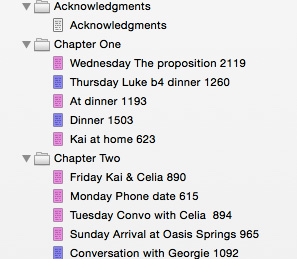 I track the days of individual books (most of which take place within the space of a few weeks) in Scrivener. After I made a character go to a government office on a Sunday, I realized I had to do something. It’s a good compromise, but once the book is done, I still have to move the big events to Aeon so they get tracked in case I need to reference them later.
I know not everyone’s a fan of Scrivener, so I thought I’d point out that you can do this same thing in Word by inserting a comment at the beginning of each scene when you are writing that tells you what day/time it is.
So there you have it. A VERY basic primer on keeping track of time when you’re writing a series.
by Laura K. Curtis | Jul 1, 2015 | Books, Freebies & Giveaways, Writing |
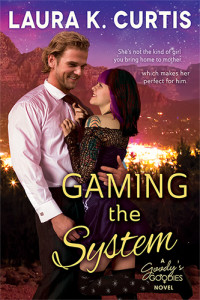 The new Goody’s Goodies book is here! Gaming the System has gotten some pretty good reviews at Goodreads already. You’ve probably heard me natter on about my punk-goth sex toy saleswoman heroine before if you follow me on social media, and I am so happy you’re finally getting to meet her!
And since I know a lot of folks like to read from the beginning of a series, I have put the first Goody’s Goodies novel, Toying With His Affections, down to free everywhere. Amazon has refused to price match thus far, only putting it down to 99¢, but I have hopes that they’ll get around to it sooner or later.
•••
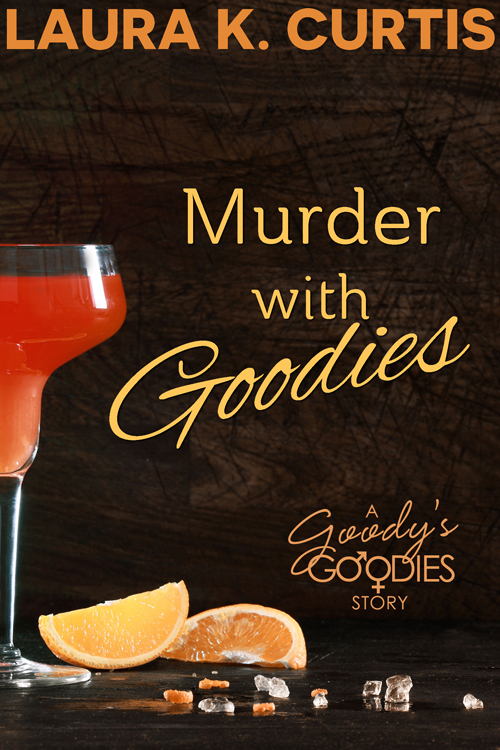
 Also, if you haven’t signed up for my newsletter yet and you like free stuff, you should sign up now! Later this month I will be releasing an exclusive free short mystery in the Goody’s world for newsletter subscribers only. Here’s a little peek at the cover. It’s a cozy mystery, not a romance, but it has a romantic element.
The newsletter signup form is right over in the sidebar there ————->
As you can also see from the sidebar, I’ll be reading at Lady Jane’s Salon in New York City in July and teaching a course on using a paper planner to achieve your goals at Savvy Authors in August. If you’re going to be at RWA in NYC, please let me know…I always love to meet people and I’ll be there!
by Laura K. Curtis | May 8, 2015 | Writing |

This afternoon, I sat down to start working on a short story I owe my friend Tommy for a charity anthology. I have no idea what it’s going to be about, really, but most of my short works are heavily mood-influenced, and I don’t think this will be any different. This may or may not be the beginning of the story. It may be something entirely else. It may be nothing at all. But it’s what I wrote today, so I thought I would share it with you.
It began with a dress. A white cotton affair with a tight bodice trimmed in eyelet and a full skirt that belled out around my knees when I pirouetted in the great hall at Rockhaven, it was the first newly store-bought item of clothing I’d ever owned. My mother gave it to me for my birthday that March. Fifteen was time to grow up, she said, to learn to be a lady rather than a ragamuffin. Mrs. Smithson, owner of the grand old Victorian ramble where my mother was housekeeper, had laughed at the comment. I think she quite liked my tomboy ways, but she bought me a string of lustrous pearls nonetheless, the most purely beautiful thing I had ever seen, to go with the dress.
We were a household of women. Male gardeners managed the small crop of fruit trees that blessed us with peaches and plums in the summer and apples and pears in the fall. Men tended the flowers, too—in the large cutting bed of annuals populated by geranium, snapdragon, larkspur, gladiolus, and zinnia—and kept the lawn and hedges neatly trimmed. But the separation of church and state had nothing on the separation of house and garden. The men rotated through, but the women in the house were my sun and moon.
Mrs. Smithson had hired my mother fresh off the boat to care for her infant son, Matthew. As long as wealthy American women had babies, my Aunt Eileen used to say, Irish girls would never want for work. But little Matthew Smithson died in a polio outbreak at only three years old and Mr. Smithson was shot in the back six months later walking home from his job on Wall Street. Mrs. Smithson sold their apartment in the city and retired to Rockhaven, their big, empty house in Roaring Brook, New York, an hour and a half north of the city she could no longer stand. She brought my mother with her to serve as housekeeper and companion, and gave her private quarters at the back of the house.
I was born after all those tragedies. After my mother’s own tragedy—the death of my father at the hands of Germans in a country so distant that even Mrs. Smithson’s money could not bring him home for burial—had bonded the two women in a dark sisterhood. The two of them were my guides, my co-mothers, and they agreed on almost everything except when it came to me.
“Be careful,” my mother would warn as I tore through the house on my way outside to dig for the elusive treasure hidden by one of Mrs. S’s ancestors. “Remember your place. This is not your house.”
“But of course it is,” Mrs. S. would say. And once, when I was about twelve, she went even further. “One day,” she told me when we were alone in the sitting room, “this will all belong to you. You must promise never, ever to sell it; it has been in my family for generations.”
Naturally, I promised. For I knew nothing, then, of taxes or maintenance or the responsibilities of my own calling.
by Laura K. Curtis | Apr 19, 2015 | Stuff!, Writing |
 Recently, I was talking to a woman I met several years ago at RWA. I don’t remember who introduced us or how we became friends, but even though we rarely see each other, even though on the surface we have little enough in common beyond being writers, we follow each other on Twitter and Facebook and chat now and then about writing things and regular life stuff. On Twitter, in Direct Messages, I said to her that I was really glad we were friends.
It was a strange moment because not too long before that, there had been one of those incredibly unhealthy things that happens in the publishing world in which the whole definition of “friendship” came into question. What makes someone your “friend?” How much communication, how many secrets do you have to share? What are the limits on friendship? How much can a “friend” go against your ethical code before you no longer consider yourselves friends? Is it possible that I am your friend, but you are not mine?
I’ve made some of my closest friends online. I started working for AOL in 1993, when I was living a very isolated life in a tiny town where I had no friends. In those days people were writing and talking about “Internet Addiction,” but most of the people I knew who spent hours and hours online weren’t addicted to “the Internet,” they were addicted to the relationships they found there. Depressives, insomniacs like me, we found support systems and communities of people who understood us as no one in our everyday lives did.
Even today, I am friends with the people I met on the night shift at AOL more than twenty years ago. I don’t see them often, but we are absolutely friends. In 2007 when I was really sick and needed someone to stay with me, one of my AOL friends lived with me for several months since he was on disability. Yes, when you meet your friends digitally, you can put your trust in the wrong people. But that can happen when you meet them in person, too. Still, friendship is a bit like porn—hard to define, but you know it when you feel it.
In all the years since I started at AOL, the Internet has become more and more social. And I, well, I have gotten less so. I moved from jobs where I dealt with the public to jobs where I see almost no one. I am a writer in the world of publishing which, as I discussed with someone on Twitter just yesterday, is an extremely unhealthy ecosystem. My friendships develop in that world, the world where insane levels of arrogance are set off by the deepest insecurity and even self-loathing, where sometimes it seems that the “happy medium” does not, cannot, exist. I have found good friends in the writing and publishing communities, people that I met in person. But I have met more of them online.
In a discussion online about the most recent brouhaha, someone told me that “exchanging a few emails and direct messages doesn’t make you friends. Friends are people you show pictures of your children to.” I left it alone because I knew we were not going to agree, but it raised a question for me. I don’t have kids. Although I am private and don’t share pictures of my lunch on Facebook, I don’t have secrets in the way most people think of them. What would I share with a “friend” that I do not share with the public?
I would contend that friendship is defined not by the quantity of communication but rather the quality. My conversations with friends go deeper, last longer. Which means that, indeed, that you can give your friendship to someone who is not your friend. You can believe that someone is your friend because you communicate freely and openly with them on the assumption that they are doing the same with you. The things they are hiding are things you don’t think to ask about because you don’t notice the absence. And yes, the Internet makes this easier. But liars and cheaters were around before the Internet, and they’ll be here when our computers crumble into dust.
Friendship, however, lasts forever.
by Laura K. Curtis | Mar 12, 2015 | Books, Writing |
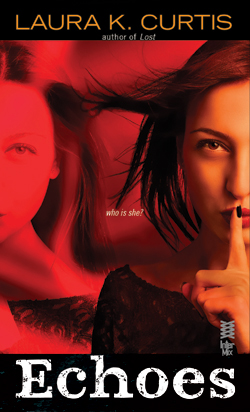
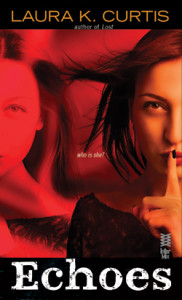 Just a quick note to say that—for you author types—I am over at Women of Mystery today talking about the cost of putting out a book and finding the right professionals to help you do it. Echoes, which comes out next week, is a Penguin book, so I didn’t have to find all that much help, but I am in the process of writing a second self-published book, so I’ve been considering a lot of the aspects that did and did not go well with Toying With His Affections.