by Laura K. Curtis | Oct 7, 2014 | Books, Writing |
Several things came together this week—the continuing uproar over the Authors United letters and/or the Amazon-Hachette issues along with Ellora’s Cave suing Dear Author—to create this post. I have many, many things to say about this, so the post is apt to be rambling and a little harsh, so I’ve illustrated it to make it a little more entertaining. And I won’t blame you if you abandon it in the middle going:

OK, got your coffee?
First, the Ellora’s Cave issue since it’s the one that got me started thinking of this post. A week or so ago, publisher Ellora’s Cave filed suit against blogger Jane Litte and her blog, Dear Author. Most of the reactions I saw were along the lines of “OMGWTFBBQ”, but several self-published authors also came out and said, if not in so many words, about the suffering Ellora’s Cave authors, “nah nah, now I bet you’re sorry you didn’t self-publish.”
This seems incredibly, unbelievably short-sighted to me. And it seems short-sighted in the same way as it did when these same authors went “Who gives a damn if Amazon bullies one or all the major publishers out of existence? They deserve it for offering their authors such crappy terms, etc.” And I say this as a self-published author.
Because here’s the thing: unless you’re selling your copies of your self-published book out of the back of your van, you’ve signed contracts with distributors. If you’re smart, you’ve signed contracts with multiple distributors. And I damn sure hope you read all of those contracts. Every last word.

I’m not talking about hitting the highlights of your contract with Kobo or iTunes or B&N or Amazon. Not just “this is how much I make per copy sold” but “this is what I am allowed to do and when I am allowed to do it.” Being self-published doesn’t mean being independent. In fact, unless you’re selling all your books directly off your own website, you’re highly dependent and you need to know what you’ve agreed to do or not do. Your contract with your book’s distributor is not like the latest upgrade agreement to Microsoft Word. (Does anyone actually read those?)
The Ellora’s Cave lawsuit is about stopping a blogger from discussing news important to the publishing industry. Whether you happen to like that blogger, like that blog, like the authors or the publisher involved, it is vitally important that conversations on topic like this not be stifled. Because as an author, as a producer who creates the content, you’re at the mercy of your distributors. (Yeah, some people can make enough selling direct off their websites or out of the back of their vans. But I’m betting the vast majority of us can’t.) So if you don’t know whether your distributors are fiscally healthy, or sane, or if they give contract terms that are standard in the industry, you don’t know what you should sign. And that matters whether you’re traditionally published, self-published, or anything in between.
And your distributor contracts may change during the course of your career, so you can’t just sign and forget about them, either. You may not be interested in Ellora’s Cave, but if EC should win that lawsuit (highly unlikely, IMHO), other sites will be less interested in exposing failures of other distributors. Since you read your contract with your distributor, you saw the part where it says that they can change the terms when they like, right? Well, when those changes happen, you read the information they send you about it, but what if you don’t understand it exactly? If publisher-agnostic sites are frightened to speak up because of lawsuits, where do you go for help?
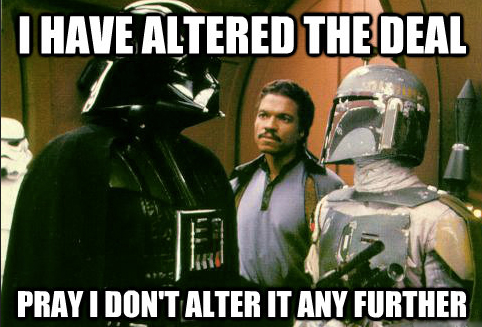 Now, of course, you have the right to pull your books out of distribution if you don’t like what what your distributor wants to do, but that’s about the only card you hold. Which is basically what’s going on with Hachette and Amazon right now. Amazon wants something and Hachette wants something else. It’s as simple, and as complex, as that. Stop for a minute and consider this: Hachette has thousands of authors, millions of dollars tied up in Amazon and they can’t get any traction in a negotiation. Do you think you will be able to if you decide you’d like to alter your deal?
I’m not a big fan of the Authors United approach. Their letter to Amazon’s board smacks of egoism and “special snowflake syndrome.” But I am even less a fan of monopsonies. I have said before that it is my absolute belief that if Amazon controls the book market, everyone—including self-publishers—will suffer. Why? Because it is not in the nature of corporations to offer favorable terms unless they absolutely have to.
This is essentially what happened with Audible—once Amazon/Audible controlled the audiobook market, they cut the royalties they gave producers/authors in half. Once they have the market, why should they pay more? And if they cut royalties, chances are authors will raise their book prices to make up some of what they lose. Which means consumer prices go up.
A competitive marketplace, with multiple distributors and lots of clarity and openness, where people are allowed to speak their mind and discuss the details of their contracts and sales, benefits everyone. It doesn’t matter whether you’re a writer or a reader. Anything that stifles discussion or creates monopolies or monopsonies should be fought tooth and nail, no matter what your publishing path may be.
by Laura K. Curtis | Oct 4, 2014 | Writing |
I may have mentioned here a time or two that I am an insomniac. Most of the time, I lie awake and toss and turn and worry and freak out about stuff I can’t handle. Occasionally, my brain turns to more productive matters. Of course, it’s never provides me with useful information about the work I am supposed to be doing (in this case, a project tentatively entitled Mind Games and set for release in November of 2015), but always something else completely.
Last night, it gave me the outline of Nash Harper’s book. If you’ve read Lost, you’ve met Nash, if only in passing. Over the next couple of books, he’ll become more important as his company, Harp Security Enterprise, begins to take center stage. But I hadn’t really considered Nash as a lead. He’s the man of mystery, the big boss, and even to me he was sort of a shadow figure.
Now, obviously, I’m not going to give you all thousand words I wrote last night…I don’t want to give away the story before I even figure it out. But I’ll pass along two paragraphs for the sake of entertainment. As usual, since it’s the beginning of the book, I’ll probably end up deleting it. But in case you’re curious about HSE, here’s a snippet.
Harp Security was not the kind of place that welcomed casual visitors. In fact, the name appeared nowhere on the outside of the building. Even the occasional lost tourist poking a head inside to ask the uniformed guard for directions could be forgiven for mistaking the 12-story building in Manhattan’s trendy TriBeCa neighborhood for nothing more than another expensive apartment complex. Which was just how Nash Harper liked it.
Only those who knew precisely what to ask for made it past that guard, and they were carefully screened by on-duty operatives before being allowed into the reception area. So when Nash’s assistant Lexie called him from reception to tell him they had a guest who wouldn’t give his name, Nash took a brief moment for a weapons check before stepping out of his office.
Now, back to work on the one that’s due!
by Laura K. Curtis | Sep 18, 2014 | Books, Romance, Writing |
So now that I’ve gotten my contract back and it’s all official and everything, I can announce that I have two more books coming from Penguin in April and November of 2015. They’re as yet untitled, but they will be romantic suspense, loosely related to each other and to TWISTED and LOST.
Also, if you’re interested in contemporary romances, I’ll have another one of those next year as well. I’d love to be able to promise you an exact date, but I can’t since it’s self-pub and highly dependent on the schedules of all the great people who help me get the self-pub work to market.
 To celebrate all this fun stuff, I am offering 20% off my contemporary romance in both print and ebook (and the sweet zombie short story I co-wrote) through my Storenvy store. Just click the picture at right and use the coupon code 20BLOG at checkout. This coupon expires October 1 at 6pm Eastern.
by Laura K. Curtis | Aug 28, 2014 | Books, Romance, Writing |
 This topic arose today on Twitter, particularly in the cases of “fated/cursed” lovers. In my first TICA—tropes I cannot abide—post I talked about alpha-holes. My dislike of insta-love isn’t as strong, but it’s still there.
I’m going to deal with the reason I dislike the “fated lovers” trope first because it’s simpler: when something is fated, there’s no escaping it. You can make it more interesting by saying they’re fated to love each other and cursed not be together, but since it’s a romance, I won’t believe the curse part. I know they’ll overcome it. And, most likely since the very concept of fate is paranormal, there will be some kind of magical “intervention” that serves as a deus ex machina, solving the curse. This is a big part of my issue with paranormal romance in general—love is hard in real life, and I prefer romance to be realistic enough to reflect that. (I know, you’re tired of me saying that, too.)
That being said, there’s plenty of insta-love in romance that isn’t fated/cursed. Boy meets girl. They fall in love right away. Events conspire to keep them apart, and the story focus is entirely on how they get back to each other. This can make for an exciting adventure story, but it doesn’t hold up as a romance for me.
Why? Because the point of a romance novel, as opposed to a novel with romantic elements, is the romance arc. If you take care of that in the first ten percent of the book, it’s not a romance. People may say “but don’t you believe in love at first sight?” Well…I believe in potential at first sight. I believe in lust at first sight. I believe in attraction at first sight. But before you know you’re in love with someone, you have to try things out. You have to find the ways in which you are, and are not, compatible. You have to spend time together…or at least have an epistolary or telephonic relationship.
I remember that after the very first time I met my husband I knew I wanted to date him. You might, given the fact that we’re now married, call it “love at first sight.” But I would call it “potential for love” at first sight. I knew we had a chance. The actual love part took longer.
When I read a romance, I want to see that potential becoming a reality. That’s the ride I sign up for when I open a romance novel. If you just say “they’re in love” and go from there, you’re cheating me out of the experience I paid for.
by Laura K. Curtis | Aug 2, 2014 | Books, Writing |
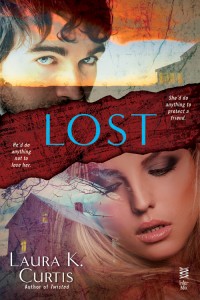 At conferences and panels, one of the questions that frequently arises is “how do you start writing?” Now, my answer to this is a little different from most: I just write. And I do it because I know I will eventually delete the first scene…or two, or three, or four. I have yet to write a book that did not require a complete rewrite of the beginning. I knew before I finished writing Twisted that I would follow it with Tara Jean’s story, but I had no idea what that story would be. At the same time, I was in a workshop in which I was required to write something I would read at a bar one night. I had something written, but I wasn’t happy with it, so at the last minute I ditched it and wrote this scene, which never made it into LOST, but did show me what the basic plot of the book would be.
Tara Jean Dobbs was not cut out to be a cult member. She didn’t know whether the plants in the field were herbs or weeds, so she couldn’t be trusted to maintain the crops. She had lousy communications skills, so she couldn’t be sent out to recruit new members. Her kindergarten teacher had remarked that she didn’t play well with others, and her first grade teacher had said she wasn’t good at sharing, neither of which had changed much in the twenty-odd years since.
And she flat out hated to follow orders.
The Leader had re-named Tara “Serena,” which she thought was pretty much the biggest crock of shit she’d ever heard. She laughed about it behind his back. Unfortunately, no one else shared her sense of humor, and she couldn’t talk to anyone outside the group, which left her to laugh alone. Not so different from her pre-cult life, really.
Theoretically, she could have had friends outside the pretty picket fence at the front of the compound, because she wasn’t locked inside. Not exactly. But if she hoped to achieve a high rank among the acolytes, to become one of the Leader’s personal attendants with the freedom to wander the great house and surrounding buildings unsupervised, she had to pretend to have no desire for outside conversation. Or cheeseburgers, diet coke, true crime novels or hot baths, dammit. And she had to put her mind to learning skills like sucking up, keeping her opinions to herself, and keeping her head down.
Tara had noticed some women seemed to be singled out for personal attention based on their looks, but that wasn’t a route she could take. God knew her parents had made that clear enough. “Your hair is a disaster, Tara Jean.” “Do you really need to eat that, Tara Jean?” “Where are we ever going to find gloves to suit those stubby fingers, Tara Jean?” The one thing she appreciated about the name Serena was that it wasn’t Tara Jean.
But although her figure was a little on the square side, and her hair curled in every direction, Tara had one thing going for her that most people in the group did not, at least as far as she could see. She had a brain. Logic and analysis were her fortes. Of course, those talents weren’t prized within the compound, but that didn’t bother her because they also weren’t recognized. The dumber she appeared, the faster she’d get what she was after. And with blonde hair and blue eyes, Tara could make herself appear pretty damned dumb. It was another lesson from her mother, who’d assured her that smart women never found husbands.
Maybe Marianne Smithfield Dobbs had been right on that score. Because sure as God made little green apples, no man had ever come knocking on Tara’s door with a ring in his pocket. When she was being particularly honest with herself, Tara could admit that precious few had come knocking at all.
But that was okay, too, because most men weren’t worth the saliva it would take to spit on them. Take the almighty Leader, for example, the benevolent father who walked among them three times a day: six in the morning, noon, and six in the evening. Occasionally, he’d turn a shovel of earth, stir the soup in the kitchen, or heal an ailing member of the congregation, but the majority of his life was spent in the ranch house with his attendants.
In public, the Leader prayed repeatedly to the Powers on how best to help his flock leave behind their worldly concerns and receive enlightenment. As far as Tara could tell, the Powers generally espoused getting rid of worldly goods, first, then worrying about worldly concerns. And since members no longer needed their iPods, cell phones, watches or jewelry, they didn’t need the cash to buy them, so the Powers recommended giving money to the Leader to help him in his crusade.
How anybody fell for this shit was beyond her.
Not that Tara was particularly materialistic. If she were, she’d still be living in Dobbs Hollow, where her family had been royalty for generations. Well, before their fall from grace, anyway. But she’d left that life behind even before she left the Hollow, and her most recent job had been as a short-order cook in a diner in the podunk town of Fayetteville, Texas. She’d actually made friends in Fayetteville. Three of them, in fact; a veritable cornucopia. And it was one of those friends, Andrea MacDonald, who’d prompted her interest in the cult. Or commune. Or whatever.
Because somewhere along the line, Andrea had become entangled with the group, and then she’d disappeared. And while Tara would never be a good cult member, she was very, very good at her true vocation.
Tara Jean Dobbs was a cop.
So there you have it. As you can see, it wouldn’t have made a good beginning to the book. Too much backstory, too much in-the-head, too much telling and not enough showing. But that’s inevitably the way I begin. Now, aren’t you glad I don’t leave it that way?
by Laura K. Curtis | Jul 28, 2014 | Books, Writing |
 RWA is over and it’s left me with some thoughts. Not deep ones, you understand—I rarely have those, and never after a conference. But it did occur to me that the two types of conferences I go to leave me in very different states. In both the mystery and romance worlds, there are “fan” cons and “professional” cons. When I come home from “fan” cons like Bouchercon or RT, I am tired. They’re fun, and the social aspect is great, and I love meeting readers and seeing my author friends, but I come home completely exhausted. My brain is fried. I can’t write for a week.
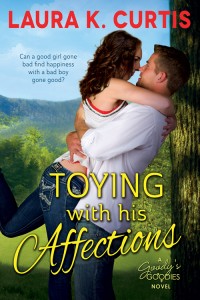
Professional cons, however, like RWA or Sleuthfest, leave me exhausted but ready to work. The panels and the agents and editors and authors are all so career-focused and full of excitement about the genre that it’s catching. I talked to some great people at RWA, and handed out a lot of cards for Toying with His Affections. I hope some people enjoy reading it, but I can’t worry too much since I have deadlines to meet. So it’s a really good thing I get some energy from the conference!
These are the books I have on tap:
1) Next romantic suspense, set partially on the beautiful island of Saint Martin/Sint Maarten. Dead bodies are piling up both stateside and in the Caribbean islands.
2) Next contemporary romance, featuring another Goody’s Goodies saleswoman, this one with a decidedly harder edge than Evie, the heroine of Toying with his Affections.
3) Fourth romantic suspense, the first one with a hero actively a part of Harp Security.
I have a lot of writing to do!!