by Laura K. Curtis | Jul 19, 2014 | Books, Writing |
I love conferences. Love them. But every year, I hear about someone who is no longer speaking to someone else because person 2 insulted person 1—or possibly insulted person 3 who is a friend of person 1—or because person 2 felt as if person 1 ignored them in favor of a more “important” author or editor.
“She looked right at me, and pretended she didn’t know me,” said one of my friends of another.
Well, yeah, that’s possible. It’s equally possible my other friend was simply on conference overload with a buzzing head and tired eyes, thinking about how much her feet hurt.
And then there are the room-mate dilemmas. “OMG,” one of my friends bemoaned in an instant message, “so-and-so asked me if I have a room-mate for RT and I don’t, but I sure as hell don’t want to room with her. What am I supposed to say?”
Well, under normal circumstances, honesty is the best policy. But there are also appropriate times for the polite lie, and this is one of them.
“You tell her you yes, you already have one,” I advised.
“And what if she finds out I don’t?”
Well, if so-and-so finds out at the conference that you don’t have a room-mate and confronts you, you have two choices. First, say your roomie fell through (which happens all the time) or you can tell her the truth. Chances are, however, that even if she does find out, she won’t say anything to you. Most people aren’t that confrontational.
And if you’re on the receiving end of “sorry, I already have a room-mate” and then later finding out that person is alone in her room? My advice is to leave it alone and assume her roomie fell through. And if you think someone’s ignoring you in favor of a more popular author or a better agent or bigger editor or whatever…make a decision about how important that is to you. I’ve been ignored numerous times at conferences. I’m a nobody. I basically expect it. I understand that people are there to network and I cannot do anything for them. The ones who want to chat with me because we are actually friends will seek me out. And if my friends are currying favor with someone else for a few minutes, well, they’ll find me later or they won’t.
Let me put this another way: RWA and Sleuthfest (and to a certain extent RT and Bouchercon) are professional conferences. People are there to do business. If you treat it as a business conference, you’re a lot less likely to get hurt than if you treat it as a social gathering. Remember that even while people are drinking and dressing up in costumes, they’re also there trying to get ahead in their careers. You may not approve of the way they do it, and that may mean cutting them out of your life, but don’t assume that just because they look past you in their search for someone at a con that they don’t like you or care about you. They’re simply wearing a business hat and not good at blending the business and social.
by Laura K. Curtis | Jun 17, 2014 | Books, Romance, Writing |
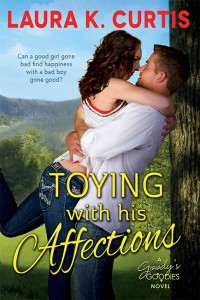 Many of you know I will be publishing my first contemporary romance this summer. This is my cover. Isn’t it pretty? And here’s the cover copy:
Good girl gone bad…
Evie Bell couldn’t wait to get out of the small town that had labeled her a goodie two-shoes growing up so she could let out her more daring side. Selling sex toys might not have been the career she envisioned when she left Fairview, TN, for Las Vegas to become a showgirl, but she’s proud of her hard-earned success. Now, forced to return to the town she’d hoped never to see again to care for her ailing aunt, she will need every bit of that pride to get along with those who disapprove of her way of life.
Bad boy gone good…
Griffin Barstow was given a choice at eighteen: jail or the military. He chose the military. Now he’s come home to Fairview to run for sheriff. But small towns have long memories and the last thing he needs while trying to convince voters he’s turned his life around is an attraction to a completely inappropriate woman.
Evie would like to avoid Griffin entirely, but her aunt’s store is in trouble only the law can help her solve. And when sparks begin to fly, both will have to decide whether a future together is possible given the issues of the past.
The thing about self-pub is that you get to experiment with a wide variety of things like pricing, sales outlets, advertising…you get the idea. One of the things I want to do with Toying with his Affections is to try some different ways of selling it. Yes, it will be available in all the standard places and in all the standard formats. Yes, you’ll be able to get it in paperback as well as e. Yes, I hope to be able to get it into library systems so that you’ll be able to get it free.
But it will also be available on my Storenvy store, which gives me the ability to send coupons. So my intention is to send out a coupon to everyone who signs up for my newsletter which will allow them to buy the book in the format of their choice for half off the cover price ($3.99 in either epub or mobi, $11.99 in print) for the first two weeks the book is on sale. The only way to get the coupon is to sign up for my newsletter, which I ONLY send out when I have books coming out, big news, or freebies I think my readers would like.
So sign up today, and be the first to get the new book…and get it at half price!
by Laura K. Curtis | Jun 8, 2014 | Books, Romance, Writing |
When I tell people that I’ve never written a query that didn’t result in a request for pages, they can’t believe it. When I tell them I ever sent out three (or six if you count the random assignments I was given to pitch to at conferences) queries, they are shocked.
But here’s the thing: I researched before I sent out my original set of queries. I looked not only at who represented what (which you can generally find on websites) but who sold what (which you can find out on Publishers Marketplace). I don’t care if an agent loves historical romance, if every sale she’s ever made is paranormal, she is probably not going to have the right set of contacts.
Because I belong to RWA, MWA, and Sisters in Crime, I am involved in a lot of discussions about queries. And I can also say that any query I’ve ever edited for someone has also resulted in a request for pages.
Your query is a super-important piece of writing. If you’re looking for an agent or editor, it may be the only piece of writing the people you want to take you on ever see. If you’re self-publishing, think of it as your cover copy—it’s the thing that’s going to make readers pick up your book.
A query letter has some basic pieces, but the one most people get wrong is the part that is like cover copy, the part that hooks an agent or editor and makes them want to find out more. Because that’s the trick—it’s not a synopsis that gives away everything in your book, it’s just a taste, a tease, a tempt.
This section needs to have three things and virtually nothing else:
- Setting
- What keeps the characters apart
- What keeps the characters together
I’ve included setting here because setting often has bearing on not only the goals and conflicts, but also on the subgenre. Someone who is looking for a small-town contemporary romance is not looking for an urban werewolf romance. You don’t need to describe the setting, just let me know where and when this takes place. The one exception to this is paranormal: in paranormal, you need a bit more world background. If your world has demons crawling up from the sewers, I need to know whether people are aware of them or not. Your world is a character, and it needs the bones sketched in.
What keeps the characters apart is vital, but I don’t have to know the details. For example, “When Molly’s fiance left her for his paralegal, she decided to stick with battery-operated boyfriends for the rest of her life.” Fine. I don’t need more. I don’t need her ex’s name or any of the details of their breakup. I don’t need to know that her father also left her mother—it will add character depth in the story, but it doesn’t need to be in the query. But let’s put Molly somewhere:
When Molly France’s fiance left her for his paralegal, she moved out of his Seattle apartment and back to the home where she grew up on Vashon Island with a chip on her shoulder and a suitcase full of battery-operated boyfriends to remind her not to trust any man. The old farmhouse, however, is in a bad way, and if she intends to use it as a home base for her new app-designing business, it’s going to need a lot of work. [OK, it’s not elegant, but I am making up as I go along, here.]
Now we have to give her a guy. He can either want her or not. Doesn’t matter, because her trust issues are enough to keep them apart.
Patrick Green has been trying to get off Vashon Island forever. Carpentry is all he knows, and saving sufficient funds to get a business off the ground in the city isn’t easy.
OK. Now, look, these two have nothing in common except that they live on the same island. If I am reading along in your query, I can see the conflict, but I don’t see any reason why he wouldn’t just ignore her completely, or why she wouldn’t just hole up in the farmhouse and nurse her wounds while looking for a job.
So we need to get them together, and keep them together. So…
Patrick Green has been trying to get off Vashon Island forever. Carpentry is all he knows, and saving sufficient funds to get a business off the ground in the city isn’t easy. When Molly first hires him to work on her house, all he sees is a path of dollar signs leading to freedom. But as passion flares between them he faces a difficult decision: will he give up the future he’s always wanted for the woman he’s beginning to love?
OK, like I said, it’s rough. But see how it sets up the situation without too many details? I don’t need to know that Molly has been working out of her boyfriend’s apartment in downtown Seattle for three years. I don’t need to know that Patrick’s parents died when he was nineteen and he’s had to take care of his siblings until this year. I don’t need the flesh of the story, just the bones. The bit that makes me go “yeah, let me see whether I want to read a few pages and see if I like the author’s voice and style.”
This is NOT a particularly good query, as far as I am concerned. Because it sounds to me as if the story is a bit empty. That’s because I haven’t written it yet and I am a pantser so I can’t write a query until after I’ve at least started the story.
Anyway, if you’re editing your own query, check and see whether you’ve hit those three points…and good luck!
by Laura K. Curtis | May 31, 2014 | Stuff!, Writing |
 Are you an author? If so, and if you’re planning on going to Bouchercon, you should sign up today! Why? Because if you don’t sign up by June 1, you won’t be on a panel! So run over to Bouchercon 2014 — Murder at the Beach right now and then come on back and read the rest of this post. Don’t worry, I’ll wait.
OK, you’re back? WHAT? You haven’t left yet? Well, let me tell you why you should.
Bouchercon, for those of you who don’t know, is a reader and writer conference. No, you don’t have to be an author. Yes, your favorite mystery and thriller authors will be there. And this year, it’s in Long Beach. Say it with me…Long Beach. Nice weather when so much of the country will be miserable.
But even without the weather, even without the beach, B’con is so worthwhile. B’con 2012 was the place I first got the chance to meet my literary idol, John Connolly. (You can read about that encounter here.) Over the past few years, I’ve both moderated and sat on panels, and in both cases I really enjoyed myself. Because B’con is a fan conference, there’s a lot more interaction between readers and writers. Yes, it’s nice to socialize with writer friends the way one does at RWA or Sleuthfest, but at B’con you also get to meet people who have actually paid money for your books. Do you know what that’s like? Because it’s pretty darned fabulous. These are people who are literally invested in you.
 And, as a fan (because, yeah, if you didn’t get it from my pathetic reaction to John Connolly, I am a fan), it’s great to be able to meet the folks whose books you’ve invested in. The people whose characters you know and love. You can hang with them in the bar and find out their deepest secrets. You can go to panels and get the scuttlebutt on what’s coming next. Who has a movie deal? Who’s starting a new series? Get books that aren’t yet available to the general public. Get books signed. Oh, the books, the books!
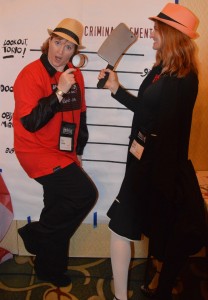
There’s also a fair amount of general silliness at Bouchercon, like the 2012 cocktail party sponsored by criminalelement.com, where attendees were provided with a mugshot backdrop and various props…and went all out! (You can see the pictures on Pinterest.) Fans and authors alike were getting goofy, and it was all-around fun.
You just never know what’s going to happen at Bouchercon. (Last year, Clare Toohey and I got kicked out of a bar before the conference even began, which I admit is something of a record.) That’s part of its charm.
And if you’re shy, or uncertain about going to a conference, this is a great one to start with. Seriously. Everyone is super-friendly and very helpful. And did I mention it’s in Long Beach?
by Laura K. Curtis | May 20, 2014 | Books, Romance, Writing |
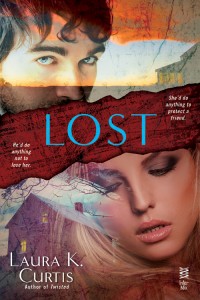 Can you tell I am just a tiny bit excited? Maybe even more so than I was for my debut. There’s something about the story of Lost that resonates for me in odd ways.
You can see an excerpt from the book on my site, and I am trying to come up with something cool to give away. I was hoping to see something while I was in New Orleans that would just speak to me, but I didn’t. If you were going to enter to win something, what would it be?
In the meantime, I have some pictures from my trip to the Romantic Times conference over on my Facebook page. It was madness. I’ve never been to RT before, so I don’t know if it’s always like that, or whether the combination of a bunch of crazed romance writers and the general decadence of New Orleans created the mania. Either way…wow. Just, wow. Even without drinking a Hurricane, the official drink of NOLA, I felt blown away!
More later, but for now, a few links to where you can find Lost:
All Romance eBooks
Amazon
Barnes & Noble
iTunes
Kobo
Enjoy!
by Laura K. Curtis | May 3, 2014 | Books, Writing |
 At the Edgar Awards the other night, I was talking to a friend about a debut book that had garnered quite a bit of acclaim a few years ago, but which neither of us had finished. The reason I couldn’t finish the book turned out to be the same as the reason she couldn’t: the author’s political agenda screamed from every page.
Now, this was an agenda I don’t happen to disagree with, but when I want analysis of political or ideological issues, I’ll grab some non-fiction. A bit of bleed-through is unavoidable—I’ve always said I don’t particularly worry about speaking freely online because if you don’t like my thoughts, you probably won’t like my books—but I don’t want to feel as if I am being hit over the head with a blunt instrument.
At lunch today I was seated next to a very nice couple. The service in the restaurant was … somewhat lacking … so we had a long time to chat. I had my notebook out and was writing and I was wearing a sweatshirt that said “Careful, or you’ll end up in my novel.” So they asked if I was a writer, and we talked about that, and then—because sports were on the TV in the restaurant and bigotry in sports is in the news—we got to discussing some political topics. And, it turned out, both the wife and I had grown up in NY, but left to go to college in the midwest. We had both been shocked at what we found in terms of sexism, racism, ethnocentrism, and homophobia. She is younger than I, and I found her experiences depressing—it was ridiculous that I should be the first Jewish person someone met at Washington University in St. Louis thirty years ago, but it’s worse that Northwestern was still segregated twenty years ago.
And, she said, the problem she really faced was that she was not Indian enough for the other Indian students. She fit nowhere.
After we talked, I went on my way and, as it does, my mind began replaying our conversation. I realized that my politics are actually not so far from my fiction as I might have at first thought.
Over the six-month period since Twisted was released, it’s been very gratifying to me to see people, particularly people whose opinions I value, examine it with some approval. Naturally, there was also some disapproval–that’s to be expected! But overall, people seemed to like it. What interested me most, however, was the analysis itself. Not “yay” or “boo” but the fact that people (both those I knew and those I didn’t) seemed willing to discuss it critically.
Twisted is, at its heart, a book about liminality and the powerlessness of those who live on the fringes of society. The murder that begins the book is the murder of a woman who lives on the edge both literally and figuratively—her house is near the woods, she makes her living as a prostitute, she drinks too much. And there are other murders (mostly of women) that are discussed (though not seen, as torture porn is a huge no-no in my eyes) throughout the book, some investigated some not, and the amount of investigation that goes into the crimes is in direct proportion to the victims’ position in society. In her analysis of Twisted, Olivia Waite says:
Of course, we do have all those nameless, faceless victims — rapes and murders and kidnappings, other cold cases that have never been solved, that may not have even been intensely investigated, which form the data constellation that helps our heroes solve Cecile’s murder. This constellation shows us exactly which groups of people are considered disposable in the small Texas town of Dobbs Hollow: prostitutes, illegal immigrants, and Hispanic women, no matter their class.
Well, yes. And although I knew that as I was writing the book, I didn’t realize it showed as much as it does. There is a certain mundane quality to evil that is hard to look at long enough to analyze. Hard to consider. Hard to face without sinking into a deep pit of despair. The idea that more people would commit more crimes if they weren’t worried about getting caught is a horrifying one. And yet, the wonderful thing about crime fiction, as Carolyn Hart said in her Grand Master address at the Edgars, is that it reaffirms for us that good does exist. That, in fact, good can triumph. And when we open a novel of a certain genre, indeed, we know that we will be transported to a place where good will triumph.
This means that every crime fiction novel presents to us, if we look, the exact ideal, the utopia of the author’s mind. In my utopia, there would be no distinction between fringe and center. No one would be victimized. People would be valued for everything they are and not devalued for what they are not.
But if I wrote that world, no one would believe it. So I write the world I see, which is decidedly less pleasant. But I write romance, which means that even though there may be a great deal of darkness, you know that the world of the novel will be better at the end than it is at the beginning.